
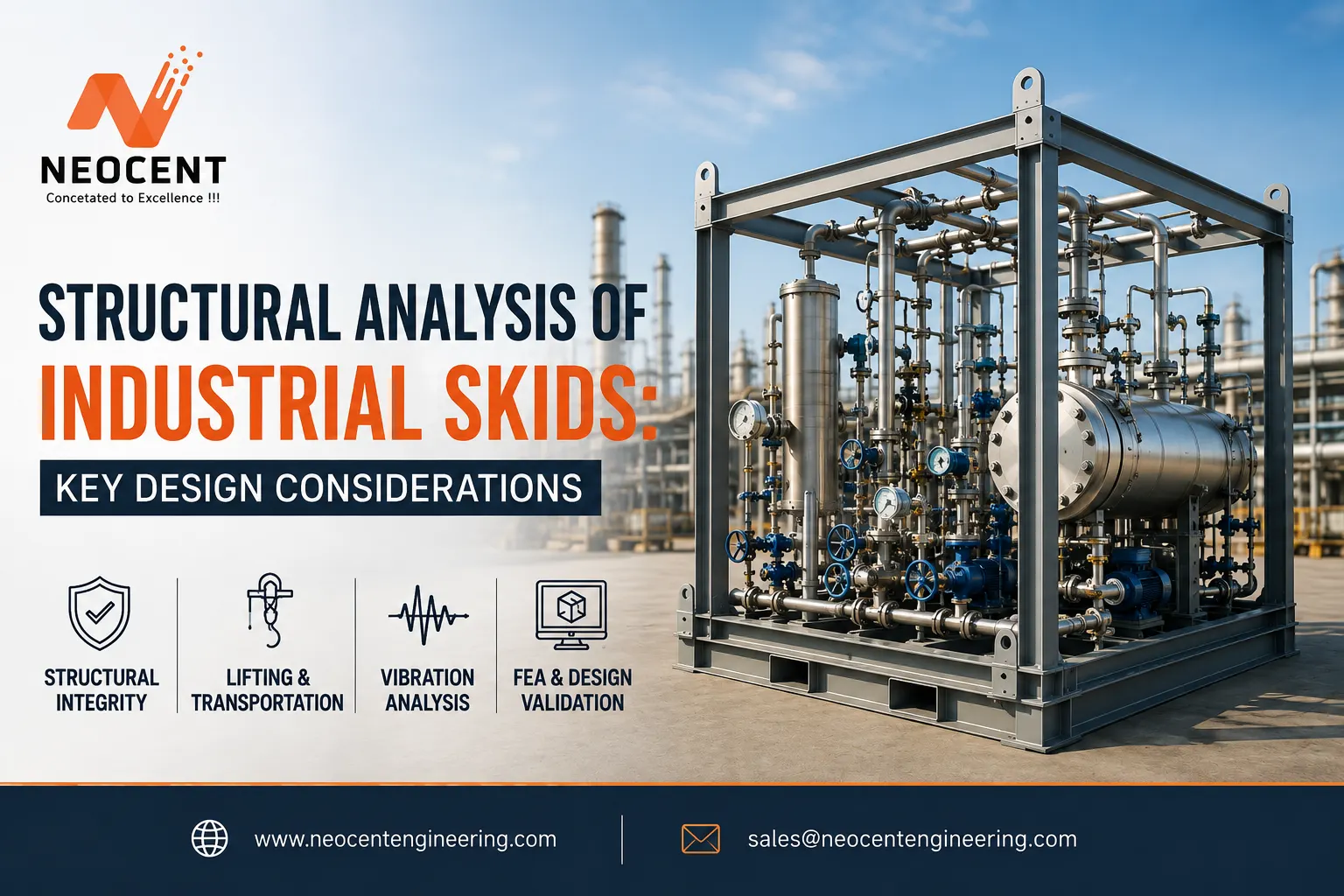
Industrial skid systems play a critical role in sectors such as oil & gas, chemical processing, pharmaceuticals, water treatment, power generation, and food manufacturing. These modular systems integrate multiple process equipment into a single transportable unit, enabling faster installation, reduced site work, and improved operational efficiency.
However, the long-term reliability of a skid package depends on one essential factor: structural analysis. Without proper engineering validation, industrial skids may experience excessive deflection, vibration, weld failures, equipment misalignment, or transportation damage, leading to costly downtime and safety risks.
This article explores the key design considerations for structural analysis of industrial skids, explains why engineering validation is essential, and highlights best practices followed by experienced engineering teams.
What Is an Industrial Skid?
An industrial skid is a pre-engineered structural frame designed to support process equipment such as pumps, compressors, heat exchangers, pressure vessels, piping, valves, instrumentation, and electrical components. The complete assembly is fabricated, tested, and commissioned before being transported to the project site.
Modern industries increasingly prefer modular skid package design because it reduces construction time, minimizes on-site installation challenges, and improves quality control through factory assembly.
Why Structural Analysis Is Essential
Every skid structure experiences multiple loading conditions throughout its lifecycle. During transportation, lifting, installation, and operation, the frame must safely support equipment loads while maintaining structural integrity.
A comprehensive structural analysis helps engineers:
- Verify structural strength
- Control excessive deflection
- Improve load distribution
- Prevent fatigue failures
- Ensure transportation safety
- Increase equipment reliability
- Optimize steel weight
- Reduce fabrication costs
Without proper analysis, even a well-fabricated skid may develop unexpected stresses that shorten its service life.
Key Design Considerations for Industrial Skid Structures
Equipment Load Assessment
The first step in structural design is identifying all static and dynamic loads acting on the skid.
Typical loads include:
- Equipment dead weight
- Operating loads
- Fluid-filled piping loads
- Maintenance loads
- Thermal expansion forces
- Wind loads (for outdoor installations)
- Seismic loads
- Transportation loads
- Lifting loads
Accurate load calculations establish the foundation for reliable structural analysis.
Frame Configuration and Member Selection
The geometry of the skid frame directly affects its stiffness and load-carrying capacity.
Engineers evaluate:
- Beam orientation
- Cross-member spacing
- Base frame dimensions
- Support locations
- Bracing arrangements
- Connection details
Proper member selection minimizes stress concentrations while maintaining fabrication efficiency.
Deflection Control
Structural strength alone is not enough.
Excessive deflection can cause:
- Pump shaft misalignment
- Piping connection failures
- Equipment vibration
- Seal leakage
- Reduced equipment performance
Finite Element Analysis (FEA) helps engineers verify that deflections remain within acceptable industry limits.
Lifting Analysis
Industrial skids are often lifted multiple times before reaching the installation site.
Typical lifting stages include:
- Workshop handling
- Truck loading
- Port handling
- Site unloading
- Final positioning
Structural analysis ensures lifting lugs, beams, and supporting members safely withstand lifting forces without permanent deformation.
Transportation Load Analysis
Transportation introduces dynamic forces significantly different from operating conditions.
Road vibrations, sudden braking, uneven surfaces, and shipping accelerations create additional stresses on the skid structure.
Engineers evaluate transportation load cases to reduce the risk of structural damage before installation.
Vibration Analysis
Many industrial skids support rotating equipment such as:
- Pumps
- Compressors
- Blowers
- Motors
- Fans
If the natural frequency of the skid approaches equipment operating frequencies, resonance may occur, causing excessive vibration and accelerated fatigue.
Dynamic analysis helps avoid these issues by optimizing structural stiffness.
Welded Connection Design
Weld failures are among the most common causes of skid structural problems.
Engineers carefully analyze:
- Weld size
- Joint configuration
- Stress concentration
- Fatigue loading
- Load transfer paths
Proper weld design significantly improves long-term reliability.
Foundation Interface Design
The skid must transfer loads safely to the supporting foundation.
Important considerations include:
- Anchor bolt locations
- Base plate design
- Support stiffness
- Grouting requirements
- Load distribution
A properly designed foundation interface minimizes settlement and equipment misalignment.
Role of Finite Element Analysis (FEA)
Finite Element Analysis has become an indispensable tool for validating industrial skid structures before fabrication.
FEA enables engineers to visualize stress distribution, identify weak areas, optimize material usage, and evaluate multiple loading scenarios without building physical prototypes.
Typical FEA outputs include:
- Von Mises stress
- Maximum displacement
- Reaction forces
- Safety factors
- Buckling analysis
- Modal analysis
- Fatigue assessment
This digital validation reduces engineering risks while improving project quality.
Material Selection Matters
Material selection affects both structural performance and lifecycle costs.
Common materials include:
- Carbon Steel
- Stainless Steel
- Structural Steel Grades
- Alloy Steel
- Hot-Dip Galvanized Steel
The final material depends on environmental exposure, corrosion resistance, operating temperature, and client specifications.
Industry Standards to Consider
Reliable skid structures are designed according to recognized engineering codes and project requirements.
Common standards include:
- ASME
- AISC
- AWS
- ISO
- API
- IS Codes (where applicable)
Compliance ensures safety, quality, and acceptance across global industrial projects.
Common Design Mistakes to Avoid
Several recurring mistakes can compromise skid performance:
- Ignoring transportation loading
- Undersized structural members
- Poor equipment load distribution
- Inadequate lifting point design
- Excessive frame deflection
- Missing vibration analysis
- Improper weld detailing
- Lack of structural validation before fabrication
Addressing these issues during the design phase is significantly more cost-effective than correcting them after fabrication.
Benefits of Professional Skid Engineering
Working with specialists offering Skid Package Design & Engineering Solutions provides several advantages:
- Improved structural reliability
- Faster project execution
- Better fabrication quality
- Reduced material waste
- Lower maintenance costs
- Enhanced operational safety
- Easier transportation and installation
- Compliance with international engineering standards
Organizations looking for skid engineering services in India increasingly rely on engineering partners capable of integrating structural analysis, equipment layout, piping, and fabrication support into a single workflow.
Choosing the Right Engineering Partner
Selecting the right engineering partner is as important as the design itself. A capable mechanical design company in India should offer multidisciplinary expertise in structural engineering, mechanical design, FEA, piping, and manufacturing support. This integrated approach ensures that every skid package is optimized for performance, safety, and ease of fabrication while meeting project timelines and quality expectations.
Conclusion
Industrial skids are much more than steel frames – they are engineered systems that must perform reliably throughout transportation, installation, and operation. Comprehensive structural analysis helps identify potential issues before fabrication, reduces project risks, improves safety, and optimizes overall project costs.
Whether designing process skids for oil & gas, chemical plants, pharmaceuticals, or water treatment facilities, engineering validation should always be an integral part of the design process.
Neocent Engineering delivers comprehensive Skid Package Design & Engineering Solutions, combining structural analysis, mechanical engineering, and design optimization to develop reliable, cost-effective industrial skid systems for global clients. With expertise in modular skid package design and advanced engineering practices, Neocent Engineering helps manufacturers and EPC companies build robust solutions that meet demanding industrial applications.
Frequently Asked Questions (FAQs)
1. What is an industrial skid package?
An industrial skid package is a modular, pre-engineered system that integrates process equipment such as pumps, vessels, piping, valves, and instrumentation onto a structural steel frame. It is fabricated and tested off-site, enabling faster installation and reduced project timelines.
2. Why is structural analysis important in skid package design?
Structural analysis ensures that the skid frame can safely withstand operational, transportation, lifting, wind, and seismic loads. It helps prevent excessive deflection, vibration, equipment misalignment, and structural failures while improving safety and reliability.
3. What are the benefits of modular skid package design?
Modular skid package design offers several advantages, including faster project execution, lower on-site construction costs, improved quality control, simplified transportation, easier installation, and reduced downtime during commissioning.
4. Which industries use skid package design and engineering solutions?
Skid Package Design & Engineering Solutions are widely used in industries such as oil & gas, chemical processing, pharmaceuticals, water treatment, power generation, food & beverage, and renewable energy, where modular process systems improve efficiency and scalability.
5. Why choose professional skid engineering services in India?
Professional skid engineering services in India provide cost-effective design, structural analysis, 3D modeling, and engineering optimization while ensuring compliance with international standards such as ASME, API, and AISC. An experienced engineering partner can help reduce project risks, improve performance, and accelerate delivery.

Krupal Patel
Krupal Patel is the CEO of Neocent Engineering Pvt. Ltd., Ahmedabad, specializing in advanced engineering solutions. With over 8 years of expertise in Product Design, FEA, CFD, and ASME-BPVC stress analysis, he has successfully delivered high-precision projects across pressure vessels, piping, and structural systems.