
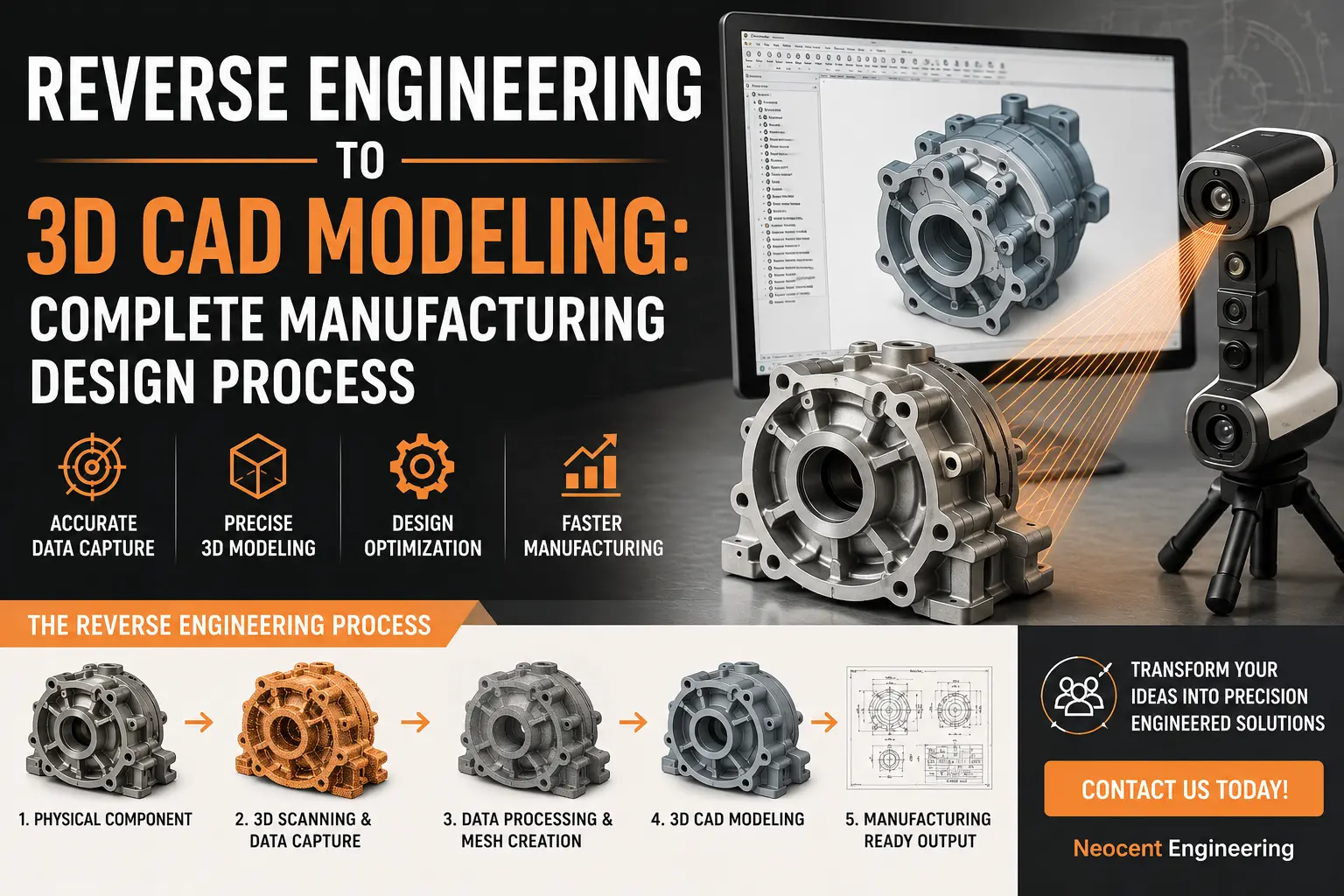
In today’s competitive industrial landscape, manufacturers and engineering companies constantly seek faster, more accurate, and cost-effective ways to develop products. One of the most effective approaches is Reverse Engineering to 3D CAD Modeling, a process that transforms physical components into precise digital models for manufacturing, redesign, analysis, and product improvement.
From automotive and aerospace to heavy machinery and industrial equipment, reverse engineering services play a vital role in modern product development. By converting existing components into editable 3D CAD models, engineers can recreate legacy parts, improve designs, and accelerate manufacturing workflows.
This guide explains the complete manufacturing design process, benefits, applications, and how businesses can leverage 3D CAD reverse engineering for efficient production.
What Is Reverse Engineering in Manufacturing?
Reverse engineering is the process of analyzing a physical object and recreating its design digitally using advanced scanning and modeling technologies. Engineers capture the dimensions, geometry, and structural details of a product and convert them into a precise 3D CAD model.
The process is widely used when:
- Original CAD files are unavailable
- Legacy components need redesigning
- Spare parts must be reproduced
- Products require performance improvement
- Manufacturers want to reduce product development time
Using advanced technologies such as 3D laser scanning, CAD conversion, and parametric modeling, reverse engineering helps industries recreate complex components accurately.
Importance of Reverse Engineering to 3D CAD Modeling
Modern industries rely heavily on 3D CAD modeling services to improve efficiency and reduce production errors. Reverse engineering bridges the gap between physical products and digital manufacturing systems.
Key Advantages:
- Faster product redesign and modification
- Improved manufacturing accuracy
- Reduced engineering costs
- Easy replication of discontinued parts
- Better quality control and inspection
- Supports product innovation and optimization
For industries dealing with old machinery or unavailable documentation, reverse engineering CAD services become essential for maintaining operations and improving product reliability.
Complete Reverse Engineering to 3D CAD Modeling Process
Physical Component Inspection
The first step involves detailed inspection of the component or assembly. Engineers evaluate:
- Dimensions
- Material properties
- Surface conditions
- Structural complexity
- Functional requirements
This stage helps determine the most suitable scanning and modeling approach.
3D Scanning and Data Collection
Advanced technologies such as:
- Laser scanning
- CMM inspection
- Photogrammetry
- 3D digitizing
are used to capture accurate geometric data from the physical object.
The collected data generates a point cloud representing the component’s shape and dimensions. High-resolution scanning ensures maximum precision for complex industrial parts.
Point Cloud Processing
Raw scan data often contains noise or unnecessary points. Engineers process and refine the scanned data to create a clean and structured model.
This step includes:
- Data alignment
- Surface reconstruction
- Mesh generation
- Error correction
Accurate point cloud processing improves the quality of the final 3D CAD design.
3D CAD Modeling
Once the scan data is optimized, engineers develop a fully editable 3D CAD model using software such as:
- SolidWorks
- AutoCAD
- CATIA
- Creo
- Siemens NX
The CAD model includes:
- Parametric features
- Surface geometry
- Assemblies
- Technical dimensions
This stage converts scanned information into a manufacturable digital design ready for engineering analysis and production.
Applications of Reverse Engineering Services
Automotive Industry
Automotive manufacturers use reverse engineering and CAD modeling for:
- Spare part reproduction
- Engine component redesign
- Performance enhancement
- Prototype development
Aerospace Engineering
In aerospace applications, reverse engineering helps recreate high-precision components while maintaining strict quality standards.
Industrial Equipment Manufacturing
Industrial companies use 3D CAD reverse engineering services to modernize outdated machinery and reproduce unavailable parts.
Oil and Gas Industry
Complex pipeline components, valves, and industrial equipment can be digitally recreated for maintenance and redesign purposes.
Medical Equipment Manufacturing
Medical device manufacturers rely on precision CAD modeling to develop accurate and customized components.
Benefits of 3D CAD Modeling for Manufacturing
Improved Product Accuracy
Digital CAD models eliminate manual drafting errors and improve dimensional precision.
Faster Product Development
Manufacturers can significantly reduce design cycles using CAD conversion services and digital engineering workflows.
Better Design Optimization
Engineers can modify and improve products easily through parametric modeling and simulation tools.
Simplified Manufacturing
Modern manufacturing technologies such as CNC machining and 3D printing directly utilize 3D CAD files for production.
Enhanced Collaboration
Digital models simplify communication between design, manufacturing, and quality control teams.
Challenges in Reverse Engineering Projects
Although highly beneficial, reverse engineering projects may involve several challenges:
- Complex geometries
- Damaged or worn-out components
- Large assembly structures
- Data processing complexity
- High precision requirements
Working with experienced engineering professionals helps ensure accurate CAD reconstruction and manufacturable designs.
How Reverse Engineering Supports Digital Manufacturing
Today’s manufacturing environment depends on digital transformation and smart engineering practices. Reverse engineering solutions support:
- Digital twin creation
- Product lifecycle management
- Manufacturing automation
- Design validation
- Simulation and analysis
By integrating 3D CAD modeling into production workflows, manufacturers improve operational efficiency and reduce downtime.
Choosing the Right Reverse Engineering Partner
Selecting the right engineering company is critical for successful project execution. Businesses should consider:
- Industry experience
- Advanced scanning technology
- CAD software expertise
- Engineering capabilities
- Quality assurance processes
Neocent Engineering provides advanced reverse engineering services, 3D CAD modeling, and manufacturing engineering solutions tailored to industrial requirements. With expertise in CAD conversion, mechanical design, and industrial engineering, the company helps businesses achieve accurate and efficient product development.
Future of Reverse Engineering and CAD Modeling
Emerging technologies such as AI-driven modeling, cloud collaboration, and automated scanning systems are transforming the future of reverse engineering and manufacturing design.
Industries increasingly adopt:
- AI-assisted CAD generation
- Smart manufacturing systems
- Digital inspection technologies
- Advanced simulation tools
These innovations help companies reduce production costs, improve design quality, and accelerate product launches.
Conclusion
Reverse Engineering to 3D CAD Modeling has become an essential part of modern manufacturing and industrial engineering. The process enables businesses to recreate, improve, and manufacture products with greater precision and efficiency.
From product redesign and spare part development to digital manufacturing integration, reverse engineering offers significant advantages across multiple industries. By leveraging advanced 3D CAD modeling services, companies can optimize workflows, reduce development time, and improve manufacturing accuracy.
Whether you need legacy component reconstruction, product optimization, or industrial CAD solutions, Neocent Engineering delivers reliable engineering support for complex manufacturing projects.
Frequently Asked Questions
1. What is reverse engineering in manufacturing?
Reverse engineering is the process of analyzing a physical product and converting it into a digital 3D CAD model for redesign, manufacturing, or product improvement.
2. Why is 3D CAD modeling important in reverse engineering?
3D CAD modeling helps create accurate digital designs that improve manufacturing precision, product modification, and engineering analysis.
3. Which industries use reverse engineering services?
Industries such as automotive, aerospace, oil & gas, heavy machinery, and industrial manufacturing commonly use reverse engineering services.
4. What technologies are used in reverse engineering?
Common technologies include 3D laser scanning, CAD software, CMM inspection, and point cloud processing tools.
5. What are the benefits of reverse engineering to 3D CAD modeling?
The process helps reduce development time, improve product accuracy, recreate legacy parts, and support efficient manufacturing workflows.

Krupal Patel
Krupal Patel is the CEO of Neocent Engineering Pvt. Ltd., Ahmedabad, specializing in advanced engineering solutions. With over 8 years of expertise in Product Design, FEA, CFD, and ASME-BPVC stress analysis, he has successfully delivered high-precision projects across pressure vessels, piping, and structural systems.