
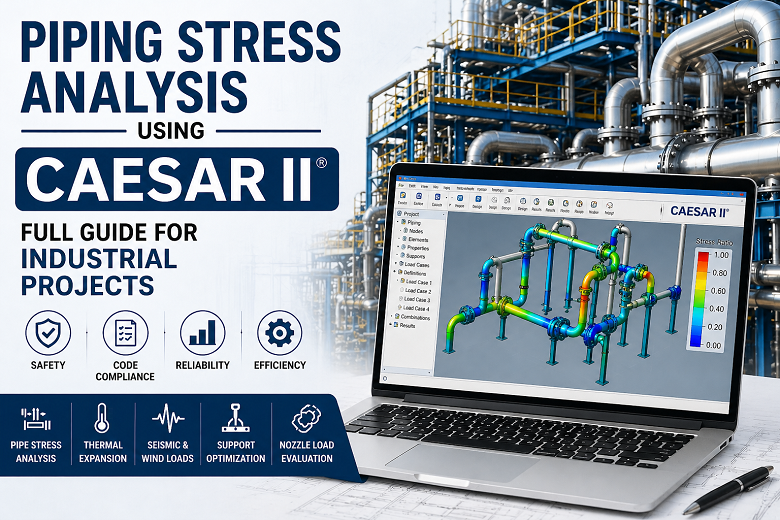
In modern industrial plants, piping systems are the backbone of safe and efficient operations. Whether it is an oil refinery, chemical plant, power station, or pharmaceutical facility, properly designed piping ensures smooth fluid transportation, operational reliability, and long-term safety. One of the most important parts of piping engineering is Piping Stress Analysis, and one of the most trusted software tools for this purpose is CAESAR II.
Piping stress analysis helps engineers evaluate how pipes behave under different operating conditions such as pressure, temperature changes, vibration, wind loads, seismic loads, and equipment movement. Without proper analysis, piping systems can fail, causing shutdowns, expensive repairs, and major safety risks.
At Neocent Engineering, advanced piping stress analysis services help industries ensure compliance, safety, and performance across complex industrial projects.
What is Piping Stress Analysis?
Piping stress analysis is the process of evaluating the mechanical behavior of a piping system under different load conditions. It helps engineers determine whether the system can safely handle operational stress without failure.
The main purpose of stress analysis is to ensure:
- Structural integrity of the piping system
- Equipment nozzle safety
- Pipe support optimization
- Compliance with international codes and standards
- Reduction of vibration and fatigue risks
- Long-term operational reliability
In simple terms, it verifies that the piping system will perform safely during normal operation and unexpected conditions.
Why is CAESAR II Used for Piping Stress Analysis?
CAESAR II is one of the most widely used piping stress analysis software solutions across industries worldwide. It is highly preferred because it helps engineers model, analyze, and validate piping systems according to major international codes such as:
- ASME B31.1
- ASME B31.3
- ASME B31.4
- ASME B31.8
- EN Codes
- API Standards
The software performs detailed analysis for:
- Sustained loads
- Expansion loads
- Occasional loads
- Dynamic loads
- Seismic analysis
- Wind load analysis
- Water hammer analysis
- Nozzle load evaluation
This makes it an essential tool for EPC companies, plant owners, and engineering consultants.
Types of Loads Considered in Piping Stress Analysis
Sustained Loads
These include constant loads such as:
- Pipe self-weight
- Internal pressure
- Insulation weight
- Fluid weight
- Valve and fitting loads
These loads remain present throughout the life of the system.
Thermal Expansion Loads
When temperature changes occur, pipes expand or contract. This movement creates stress on the system and connected equipment.
Thermal stress analysis helps prevent:
- Pipe cracking
- Nozzle failures
- Equipment misalignment
- Support failures
This is one of the most critical parts of industrial piping design.
Occasional Loads
These include temporary but high-impact forces such as:
- Wind loads
- Seismic loads
- Relief valve discharge
- Water hammer
- Pressure surges
Ignoring these loads can lead to catastrophic plant failures.
Step-by-Step Process of Piping Stress Analysis Using CAESAR II
Step 1: Data Collection
Engineers first gather important project details including:
- P&ID drawings
- Piping layouts
- Isometric drawings
- Operating temperatures
- Design pressure
- Pipe material specifications
- Support locations
- Equipment nozzle details
Accurate input data is essential for reliable analysis.
Step 2: 3D Modeling of the Piping System
The piping system is modeled inside CAESAR II using nodes, pipe dimensions, supports, restraints, and equipment connections.
This digital model acts as the foundation for analysis.
Step 3: Load Case Definition
Different load cases are created such as:
- Operating case
- Shutdown case
- Hydrotest case
- Seismic case
- Wind case
- Start-up and upset conditions
Each load case is analyzed separately for accurate results.
Step 4: Code Compliance Check
The software checks whether the piping system complies with applicable design codes such as ASME B31.3.
If stress exceeds allowable limits, modifications are required.
Step 5: Optimization and Recommendations
Engineers optimize the system by adjusting:
- Pipe routing
- Support locations
- Spring supports
- Expansion loops
- Expansion joints
- Anchor positions
This improves system flexibility and reduces excessive stress.
Common Problems Solved by Piping Stress Analysis
Proper piping stress analysis helps solve major industrial issues such as:
Equipment Nozzle Failure
Excessive piping loads can damage pumps, compressors, turbines, and heat exchangers.
Pipe Vibration
High vibration can cause fatigue failures and maintenance issues.
Support Failure
Incorrect support placement creates overload conditions.
Excessive Thermal Expansion
Uncontrolled expansion causes pipe displacement and equipment damage.
Plant Shutdown Risks
Unexpected piping failure can stop production and increase downtime costs.
This is why professional engineering review is critical for every industrial project.
Industries That Require CAESAR II Stress Analysis
Many industries depend heavily on piping stress analysis, including:
- Oil and Gas
- Petrochemical Plants
- Power Plants
- Chemical Industries
- Fertilizer Plants
- Water Treatment Plants
- Pharmaceutical Manufacturing
- LNG Facilities
- Food Processing Plants
For these industries, piping reliability directly affects production efficiency and safety standards.
Why Choose Professional Engineering Support?
While software is powerful, successful piping stress analysis depends on engineering expertise. Experienced consultants understand practical field challenges, code interpretation, and optimization strategies that software alone cannot solve.
Neocent Engineering provides specialized piping engineering solutions for industrial projects with a strong focus on compliance, performance, and cost optimization. Their expertise in piping design, stress analysis, and engineering validation supports safer and more reliable plant operations.
Conclusion
Piping stress analysis using CAESAR II is not just a design requirement – it is a critical safety and reliability practice for every industrial project. From thermal expansion to seismic loads and equipment protection, proper analysis prevents failures and improves plant efficiency.
Industries that invest in professional piping stress analysis reduce long-term maintenance costs, improve operational safety, and achieve better compliance with international engineering standards.
For companies handling complex industrial piping systems, expert engineering support makes a major difference in project success. Proper stress analysis today prevents costly failures tomorrow.
FAQs
1. What is piping stress analysis?
Piping stress analysis is the process of checking whether a piping system can safely handle pressure, temperature changes, weight, vibration, and external loads without failure.
2. Why is CAESAR II used for piping stress analysis?
CAESAR II is used because it helps engineers analyze piping systems accurately and ensures compliance with standards like ASME B31.3 and other international codes.
3. Which industries need piping stress analysis?
Industries like oil and gas, chemical plants, power plants, refineries, pharmaceuticals, and water treatment facilities require piping stress analysis for safe operations.
4. What are the common causes of piping failure?
Common causes include thermal expansion, poor pipe support design, excessive vibration, pressure surges, and improper nozzle load management.
5. How does piping stress analysis improve plant safety?
It helps prevent pipe leaks, equipment damage, support failures, and unexpected shutdowns by ensuring the piping system performs safely under all operating conditions.

Krupal Patel
Krupal Patel is the CEO of Neocent Engineering Pvt. Ltd., Ahmedabad, specializing in advanced engineering solutions. With over 8 years of expertise in Product Design, FEA, CFD, and ASME-BPVC stress analysis, he has successfully delivered high-precision projects across pressure vessels, piping, and structural systems.