
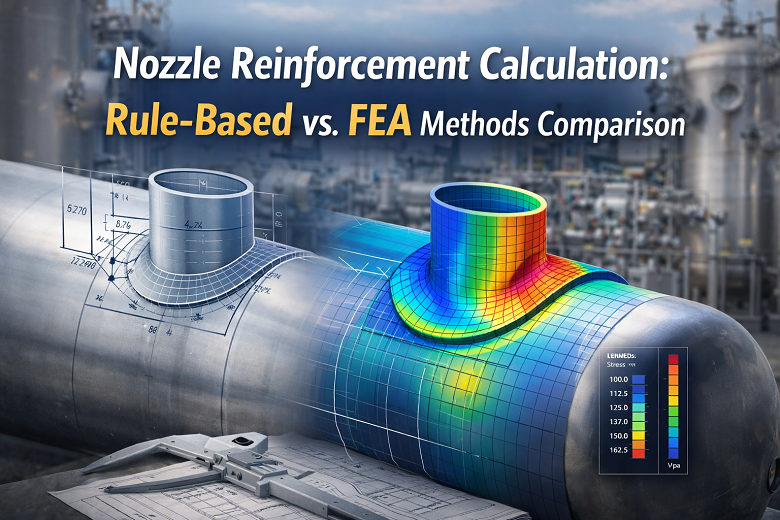
In the world of pressure vessel design, ensuring structural integrity at nozzle openings is critical to prevent failures under high pressure and temperature conditions. Nozzle reinforcement calculations help determine if additional material is needed around these openings to compensate for the removed section. This blog post dives into a detailed comparison between traditional rule-based methods and advanced Finite Element Analysis (FEA) approaches. Whether you’re an engineer in India, the USA, the UK, UAE, or Canada seeking FEA consulting services, understanding these methods can optimize your designs for compliance and efficiency.
As a leading provider of Finite Element Analysis services in India, Neocent Engineering specializes in helping global clients navigate complex calculations like nozzle reinforcement. Our expertise as one of the top Finite Element Analysis companies ensures precise, code-compliant solutions using tools like ANSYS and Abaqus.
What is Nozzle Reinforcement in Pressure Vessels?
Nozzle reinforcement refers to the process of calculating and adding material around nozzle openings in pressure vessels to maintain strength and prevent stress concentrations. These openings, used for piping connections or instrumentation, weaken the vessel wall, making reinforcement essential for safety and longevity.
According to ASME Section VIII Division 1 (UG-37), reinforcement compensates for the area removed by the opening. This is crucial in industries like oil and gas, chemical processing, and power generation, where vessels operate under extreme conditions. Without proper reinforcement, risks include leaks, cracks, or catastrophic failures.
Traditional methods rely on empirical rules, while modern FEA consulting services offer simulation-based insights. Let’s explore both.
Rule-Based Methods for Nozzle Reinforcement Calculation
Rule-based methods, often called “area replacement” techniques, are outlined in codes like ASME VIII Div. 1. These involve simple formulas to calculate the required reinforcement area.
Key Steps in Rule-Based Calculation:
- Determine the Opening Size: Measure the diameter of the nozzle and the vessel wall thickness.
- Calculate Required Area: Use formulas like A=d×tr A = d \times t_r A=d×tr, where d d d is the opening diameter and tr t_r tr is the required thickness.
- Available Reinforcement Area: Account for excess material in the nozzle neck, vessel shell, and any added pads.
- Check Compliance: Ensure the available area meets or exceeds the required area.
Advantages:
- Quick and straightforward, ideal for preliminary designs.
- No need for specialized software or expertise in Finite Element Analysis services.
- Cost-effective for standard configurations.
Disadvantages:
- Conservative estimates may lead to over-design, increasing material costs.
- Limited accuracy for complex geometries, like oblique nozzles or high-pressure scenarios.
- Doesn’t account for real-world stress distributions, such as thermal gradients or cyclic loading.
Many Finite Element Analysis companies recommend rule-based methods for simple vessels but advise switching to FEA for intricate projects.
Finite Element Analysis (FEA) Methods for Nozzle Reinforcement
FEA, or Finite Element Analysis, uses computational modeling to simulate stress, strain, and deformation in nozzle areas. As providers of Finite Element Analysis services in India, we at Neocent Engineering employ FEA to deliver detailed insights beyond rule-based limits.
How FEA Works for Nozzle Reinforcement:
- Model Creation: Build a 3D model of the vessel and nozzle using CAD software.
- Meshing: Divide the model into finite elements for numerical analysis.
- Apply Loads and Boundaries: Simulate internal pressure, external forces, and thermal conditions.
- Solve and Analyze: Use software to compute stress concentrations, ensuring compliance with ASME VIII Div. 2 (Design by Analysis).
FEA consulting services excel in handling non-standard nozzles, such as those with hillsides or set-in configurations, providing visualizations of stress hotspots.
Advantages:
- High accuracy in predicting real-world behavior, reducing over-design by up to 20-30%.
- Accounts for multiple load cases, including fatigue and seismic effects.
- Optimizes material use, lowering costs for large-scale projects.
Disadvantages:
- Requires specialized software and skilled engineers from reputable Finite Element Analysis companies.
- Time-intensive setup and computation, though AI integration in 2026 is speeding this up.
- Higher initial costs, but offset by long-term savings.
In regions like the USA and UK, where stringent regulations apply, FEA is increasingly mandated for critical applications.
Rule-Based vs. FEA: A Head-to-Head Comparison
When comparing rule-based and FEA methods for nozzle reinforcement calculation, several factors stand out:
Aspect | Rule-Based Methods | FEA Methods |
Accuracy | Moderate; conservative assumptions | High; detailed stress mapping |
Complexity Handling | Simple geometries only | Complex shapes and loads |
Time Required | Hours | Days (faster with modern tools) |
Cost | Low | Higher upfront, but efficient |
Code Compliance | ASME VIII Div. 1 | ASME VIII Div. 2 (more flexible) |
Best For | Standard vessels | Custom, high-risk designs |
Rule-based methods are like a quick checklist – efficient but limited. FEA, offered through specialized FEA consulting services, is a full simulation, revealing nuances like peak stresses at weld junctions. For instance, in a high-pressure reactor, rule-based might overestimate reinforcement by 15%, while FEA optimizes it precisely.
Data from industry reports shows that Finite Element Analysis services in India help reduce project timelines by integrating FEA early, benefiting clients in Canada and beyond.
When to Choose Rule-Based vs. FEA for Your Project
- Opt for Rule-Based: For small-diameter nozzles in low-pressure vessels where quick approvals are needed. Ideal for initial feasibility studies or when budget constraints limit access to Finite Element Analysis companies.
- Choose FEA: In cases involving large openings, exotic materials, or multi-axial stresses. Essential for ASME U-stamp certification in critical industries. If your project involves fatigue analysis or thermal transients, FEA consulting services are indispensable.
At Neocent Engineering, a premier provider of Finite Element Analysis services in India, we often start with rule-based checks and escalate to FEA for validation, ensuring cost-effective outcomes.
Benefits of Partnering with Finite Element Analysis Companies
Outsourcing to Finite Element Analysis companies like ours offers global access to expertise without in-house overheads. Based in Ahmedabad, India, we serve clients in the USA, UK, and Canada with remote FEA consulting services, delivering reports compliant with international codes. Our AI-enhanced workflows in 2026 ensure faster iterations, making us a go-to for efficient nozzle reinforcement solutions.
Conclusion
Nozzle reinforcement calculation is pivotal for safe pressure vessel design. While rule-based methods provide a solid foundation, FEA methods offer superior precision for modern challenges. By understanding this comparison, engineers can make informed choices to enhance safety and efficiency.
If you’re exploring FEA consulting services or need Finite Element Analysis services in India, contact Neocent Engineering today. Our team of experts is ready to assist with your next project.
FAQs
1. What is the main difference between rule-based and FEA methods for nozzle reinforcement?
Rule-based methods use simple formulas for area replacement, while FEA simulates detailed stress distributions for more accurate results.
2. When should I use FEA consulting services for nozzle calculations?
Use FEA for complex geometries, high-pressure applications, or when precise optimization is needed to reduce material costs.
3. Are Finite Element Analysis services in India compliant with ASME standards?
Yes, reputable Finite Element Analysis companies in India ensure full compliance with ASME VIII Div. 1 and Div. 2.
4. How does FEA improve nozzle reinforcement over rule-based approaches?
FEA accounts for real-world factors like thermal stresses and fatigue, often leading to lighter, more efficient designs.
5. What industries benefit most from Finite Element Analysis companies for nozzle design?
Oil and gas, chemical processing, and power generation industries rely on FEA for safe, code-compliant nozzle reinforcements.

Krupal Patel
Krupal Patel is the CEO of Neocent Engineering Pvt. Ltd., Ahmedabad, specializing in advanced engineering solutions. With over 8 years of expertise in Product Design, FEA, CFD, and ASME-BPVC stress analysis, he has successfully delivered high-precision projects across pressure vessels, piping, and structural systems.