
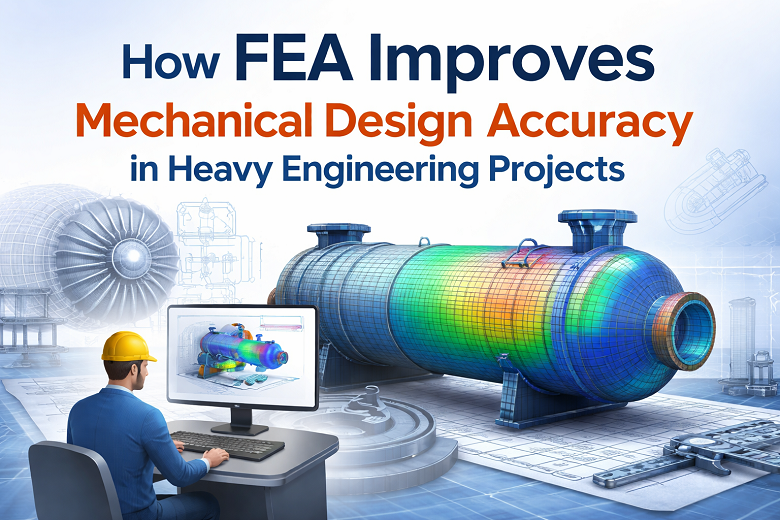
Start the blog by explaining how heavy engineering projects such as pressure vessels, skid-mounted systems, and industrial piping demand extremely high design accuracy. In India, where equipment is often designed for both domestic use and global export, even minor design miscalculations can lead to safety risks, rework, or non-compliance with ASME and international standards.
Introduce Finite Element Analysis (FEA) as a critical engineering tool that enables engineers to simulate real-world operating conditions and validate mechanical designs before fabrication. Emphasize how FEA has become an essential part of modern mechanical design engineering services in India, especially for heavy-duty industrial applications.
Understanding Finite Element Analysis in Mechanical Design
In this section, explain Finite Element Analysis in a practical, industry-oriented way. Describe how complex mechanical components are divided into smaller elements to evaluate stress, strain, deformation, and thermal behavior under different load conditions. Avoid theoretical depth and instead focus on how FEA fits into real engineering workflows.
Explain that FEA bridges the gap between traditional hand calculations and actual operating conditions, allowing engineers to analyze complex geometries and loading scenarios that are common in heavy engineering projects.
Importance of Design Accuracy in Heavy Engineering Projects
Here, explain why design accuracy is non-negotiable in heavy engineering. Discuss how overdesign increases material cost and fabrication weight, while underdesign can result in structural failure, fatigue cracking, or equipment shutdown.
Highlight the Indian industrial context where pressure vessels, piping systems, and skids often operate under high pressure, elevated temperatures, and cyclic loading. Explain how accurate mechanical design directly impacts safety, compliance, equipment lifespan, and operational efficiency.
Role of FEA in Improving Mechanical Design Accuracy
This section should be the core of the blog and written in continuous explanatory paragraphs, not bullets.
Explain how FEA allows engineers to predict stress distribution and deformation across mechanical components with high precision. Describe how localized stress concentrations, which are often missed in conventional calculations, can be identified early using FEA.
Discuss how multiple load cases such as operating loads, test conditions, wind loads, seismic loads, and thermal expansion can be simulated to ensure the design performs safely under all scenarios. Emphasize that this capability significantly improves overall mechanical design accuracy.
Design Validation Before Manufacturing
In this section, explain how FEA helps validate designs before fabrication begins. Describe how virtual testing reduces the need for costly physical prototypes and minimizes late-stage design changes.
Mention that FEA-based validation is especially important for Indian manufacturers supplying equipment to global EPC contractors, where compliance with ASME and customer specifications is mandatory. Reinforce that early validation through FEA saves time, cost, and project risk.
Fatigue, Thermal, and Non-Linear Analysis Using FEA
Dedicate this section to explaining how FEA handles complex real-world conditions. Discuss fatigue analysis for cyclic loading, thermal analysis for high-temperature equipment, and non-linear analysis for contact, material plasticity, and large deformation scenarios.
Explain how these advanced FEA studies improve design reliability and help engineers predict long-term equipment performance. Keep the explanation practical and linked to heavy engineering use cases rather than academic theory.
Application of FEA in Heavy Engineering Equipment
This section should flow as a narrative explaining how FEA is applied across different equipment types.
Describe how FEA is used in pressure vessel design to verify stress limits as per ASME Section VIII. Explain its role in skid design by evaluating structural integrity during lifting, transportation, and operation. Also discuss how FEA supports piping system design by analyzing expansion stresses, support loads, and nozzle interactions.
Why FEA-Based Design Is Growing in India
Explain why Indian industries are increasingly adopting FEA-based mechanical design. Talk about globalization, stricter safety regulations, rising material costs, and the need for export-quality equipment.
Highlight how engineering consulting firms in India now offer specialized FEA consulting services to support EPC companies, OEMs, and fabricators. This section reinforces location-based relevance without sounding forced.
Selecting the Right FEA Engineering Partner
Here, guide readers on what to look for in an FEA service provider. Focus on experience in heavy engineering, knowledge of ASME codes, capability to handle complex simulations, and ability to deliver clear engineering reports.
Conclusion
Conclude by reinforcing that Finite Element Analysis is no longer optional in heavy engineering projects. Summarize how FEA improves mechanical design accuracy, enhances safety, ensures code compliance, and reduces project risk.
End with a strong but subtle CTA encouraging industries to adopt FEA-driven design approaches for reliable and efficient mechanical systems.
FAQ
1. What is FEA and why is it important in mechanical design?
Finite Element Analysis (FEA) is a simulation method used to evaluate stress, deformation, and thermal behavior in mechanical components. It is important because it improves design accuracy, reduces failure risk, and validates performance before manufacturing.
2. How does FEA improve accuracy in heavy engineering projects?
FEA improves accuracy by simulating real operating conditions such as pressure, temperature, and external loads. It identifies stress concentrations and design weaknesses that are difficult to predict using conventional calculation methods.
3. Is FEA mandatory for pressure vessel and industrial equipment design?
While FEA is not always mandatory, it is often required for complex pressure vessels, non-standard geometries, and high-load equipment. Many ASME-based designs use FEA to demonstrate compliance and design safety.
4. What types of mechanical equipment commonly require FEA analysis?
FEA is commonly used for pressure vessels, heat exchangers, skid-mounted systems, industrial piping, structural frames, and heavy rotating or static equipment operating under high stress or temperature.
5. Why should Indian industries use FEA-based mechanical design services?
Indian industries use FEA-based design to meet international codes, reduce material cost, improve safety, and ensure reliable performance in export-oriented and EPC projects across oil, gas, power, and process industries.

Krupal Patel
Krupal Patel is the CEO of Neocent Engineering Pvt. Ltd., Ahmedabad, specializing in advanced engineering solutions. With over 8 years of expertise in Product Design, FEA, CFD, and ASME-BPVC stress analysis, he has successfully delivered high-precision projects across pressure vessels, piping, and structural systems.