
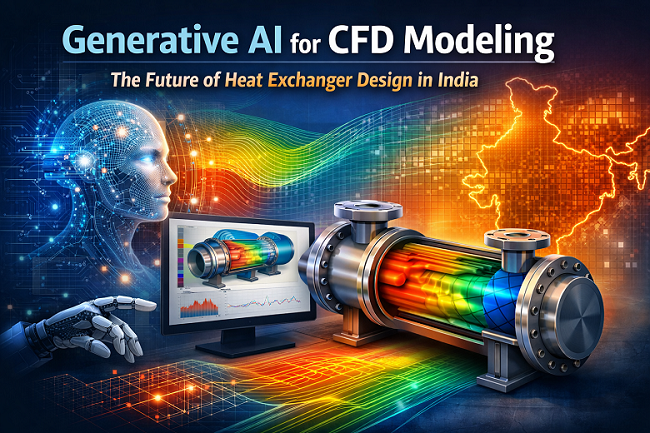
In the rapidly evolving landscape of mechanical engineering, generative AI in CFD modeling is emerging as a game-changer for heat exchanger design. As India pushes towards energy efficiency and sustainable manufacturing in sectors like oil & gas, chemical processing, and power generation, integrating artificial intelligence in computational fluid dynamics promises faster, more innovative, and cost-effective solutions. This article explores how generative AI for heat exchanger design is shaping the future, particularly in the Indian context.
What is Generative AI in CFD Modeling?
Computational Fluid Dynamics (CFD) has long been the cornerstone of simulating fluid flow, heat transfer, and pressure drops in heat exchangers. Traditional CFD relies on manual geometry creation, meshing, and iterative simulations, which can take hours or days.
Generative AI changes this by using algorithms—such as diffusion models, generative adversarial networks (GANs), and physics-informed neural networks (PINNs)—to automatically generate and optimize designs. These tools explore thousands of design variations, predicting performance without running full simulations each time.
Key applications include:
- Topology optimization for complex internal geometries (e.g., triply periodic minimal surfaces or TPMS).
- Surrogate modeling to accelerate CFD predictions.
- Automated design of microchannel or compact heat exchangers.
Recent advancements, like AI-driven Bayesian optimization integrated with CFD, have enabled rapid prototyping of 3D-printed heat exchangers with superior thermal-hydraulic performance.
Benefits of Generative AI for Heat Exchanger Design
Adopting generative AI in heat exchanger CFD offers transformative advantages:
- Faster Design Cycles: Traditional CFD simulations for a single heat exchanger geometry can take hours. AI surrogates reduce this to minutes, allowing engineers to evaluate thousands of options.
- Improved Performance: Generative designs often achieve 20-60% better heat transfer efficiency while minimizing pressure drops. For instance, AI-optimized copper heatsinks have shown +60% heat transfer gains.
- Cost Reduction: By predicting outcomes early, AI minimizes physical prototyping and material waste—critical for India’s manufacturing sector.
- Handling Complexity: Generative AI excels at nonlinear problems, such as turbulent flow in shell-and-tube or plate-fin heat exchangers, where traditional methods struggle.
- Sustainability: Optimized designs lower energy consumption, aligning with India’s net-zero goals.
Studies show AI models trained on CFD data can predict Nusselt numbers, friction factors, and effectiveness with high accuracy, outperforming conventional correlations.
Real-World Applications and Case Studies
Globally, tools like Diabetes’s ColdStream use generative AI for CFD to design optimal cooling solutions, exploring designs beyond human intuition.
In heat exchangers specifically:
- AI-driven frameworks have optimized pillar-based microchannel designs, improving efficiency by 10-34%.
- Integration with additive manufacturing enables complex TPMS structures, reducing pressure drops by up to 38%.
In India, thermal engineering firms are adopting AI for predictive maintenance and optimization in power plants and HVAC systems. With growing data centers and EV battery thermal management needs, AI in heat exchanger design India is poised for explosive growth.
Neocent Engineering, specializing in CFD simulations and heat exchanger design per standards like ASME and TEMA, is at the forefront—leveraging these tools to deliver compliant, high-performance solutions for Indian industries.
The Future of Heat Exchanger Design in India
By 2026 and beyond, generative AI CFD heat exchangers will dominate:
- Hybrid physics-AI models (e.g., PINNs) for real-time simulations.
- Open-source AI frameworks improving turbulence modeling in printed circuit heat exchangers.
- Increased adoption in India’s booming sectors: renewables, chemicals, and pharmaceuticals.
Challenges remain, such as data quality and model interpretability, but India’s vibrant AI ecosystem—ranking high in ML-enabled research—positions it as a leader.
Indian engineers can expect tools that reduce design time from weeks to days, fostering innovation in energy-efficient heat exchangers.
Challenges and Considerations
While promising, implementation requires:
- High-quality training data from validated CFD runs.
- Balancing AI “black-box” nature with engineering interpretability.
- Computational resources for initial model training.
Overcoming these will unlock full potential, especially in resource-constrained settings common in Indian SMEs.
Conclusion: Embracing the AI Revolution in Thermal Engineering
Generative AI for CFD modeling is not just a trend—it’s the future of heat exchanger design in India. By enabling smarter, faster, and greener solutions, it empowers engineers to tackle complex challenges in fluid flow and heat transfer.
At Neocent Engineering, we’re committed to integrating these technologies into our FEA, CFD, and pressure vessel services. Contact us to explore how AI-optimized designs can elevate your next project.
Frequently Asked Questions
1. What is Generative AI in CFD Modeling for Heat Exchanger Design?
Generative AI uses advanced algorithms like generative adversarial networks (GANs), diffusion models, and physics-informed neural networks (PINNs) to automatically create and optimize heat exchanger geometries. Unlike traditional CFD, which relies on manual design and iterative simulations, generative AI explores thousands of design variations, predicting fluid flow, heat transfer, and pressure drops to propose innovative structures (e.g., TPMS or microchannel designs) that enhance performance.
2. How Does Generative AI Improve Heat Exchanger Design Compared to Traditional Methods?
Generative AI accelerates design cycles by reducing simulation time from hours to minutes using surrogate models. It achieves 20-60% better heat transfer efficiency, lower pressure drops (up to 38% in some cases), and superior optimization for complex flows. Tools like Bayesian optimization integrated with CFD enable exploration of non-intuitive designs, often outperforming human-engineered solutions while minimizing material use and costs.
3. What Are the Key Benefits of Using Generative AI for Heat Exchangers in Indian Industries?
In sectors like oil & gas, chemicals, power generation, and renewables, generative AI drives energy efficiency, reduces prototyping costs, and supports sustainability goals (e.g., India’s net-zero targets). It optimizes for local challenges like high ambient temperatures and resource constraints, enabling compact, high-performance designs for data centers, EV battery cooling, and manufacturing—potentially cutting energy consumption and fostering innovation in Indian SMEs.
4. What Challenges Exist in Adopting Generative AI for CFD-Based Heat Exchanger Design?
Major hurdles include the need for high-quality training data from validated CFD simulations, the “black-box” nature of AI models (reducing interpretability for engineering decisions), high initial computational resources for training, and integration with standards like ASME or TEMA. In India, additional issues involve data scarcity in SMEs and skill gaps, though growing AI ecosystems are addressing these.
5. What is the Future Outlook for Generative AI in Heat Exchanger CFD Modeling by 2026?
By 2026, expect hybrid physics-AI models for real-time simulations, wider adoption of tools like PINNs for turbulence and multiphase flows, and integration with additive manufacturing for complex geometries. In India, increased use in renewables and pharmaceuticals will drive growth, with AI reducing design times from weeks to days and enabling greener, more compliant heat exchangers.

Krupal Patel
Krupal Patel is the CEO of Neocent Engineering Pvt. Ltd., Ahmedabad, specializing in advanced engineering solutions. With over 8 years of expertise in Product Design, FEA, CFD, and ASME-BPVC stress analysis, he has successfully delivered high-precision projects across pressure vessels, piping, and structural systems.