
Introduction
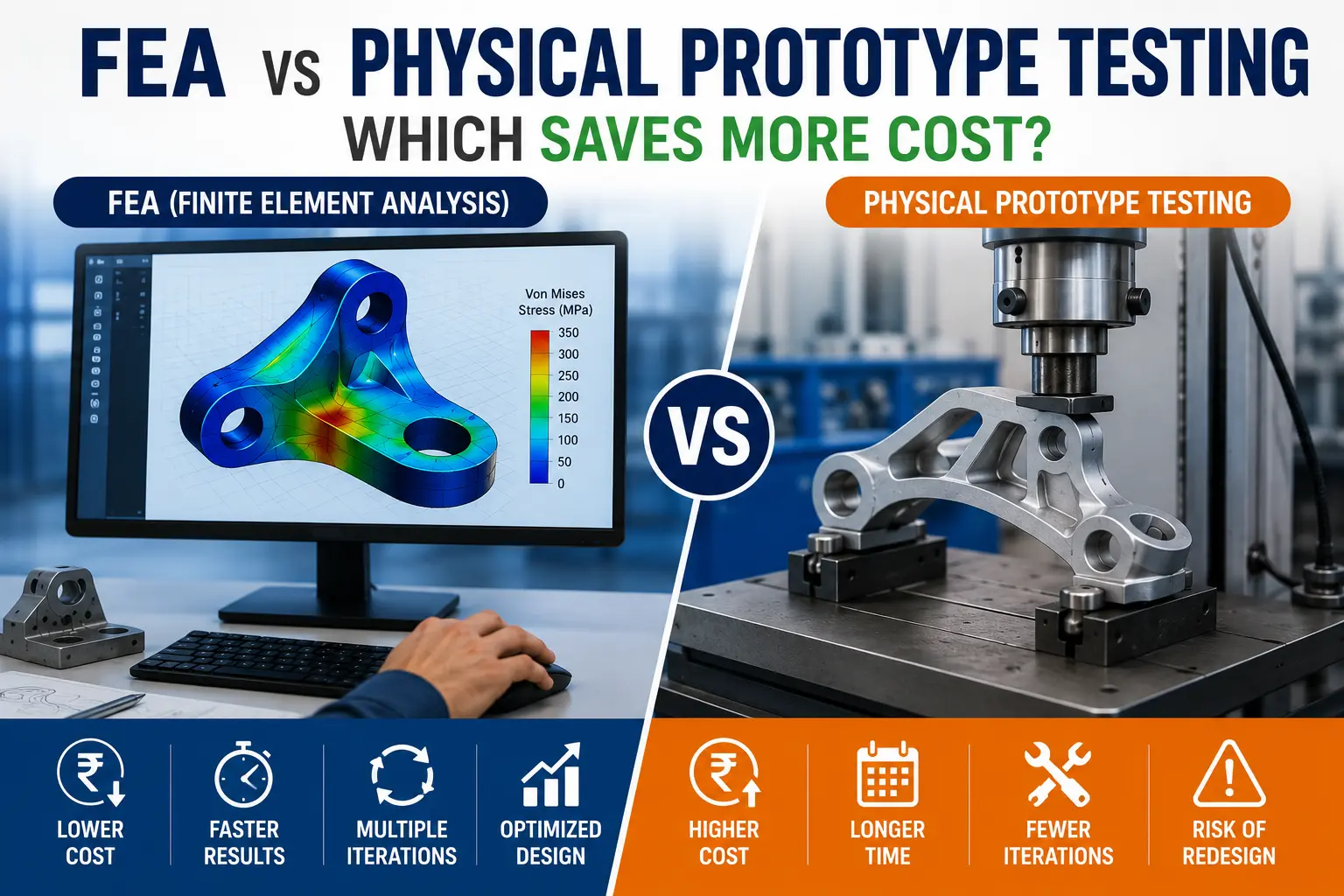
In today’s competitive engineering and manufacturing landscape, companies are constantly searching for ways to reduce product development costs while maintaining quality, performance, and reliability. One of the biggest decisions during product development is choosing between Finite Element Analysis (FEA) and physical prototype testing.
Both methods play a crucial role in product validation, but they differ significantly in terms of cost, development time, accuracy, and resource utilization. As digital engineering technologies continue to advance, many organizations are increasingly adopting Finite Element Analysis Services India to minimize risks and optimize designs before investing in expensive physical prototypes.
This article explores the differences between FEA and physical prototype testing and evaluates which approach ultimately delivers greater cost savings.
What is Finite Element Analysis (FEA)?
Finite Element Analysis (FEA) is a computer-based simulation technique used to predict how a product or component will behave under real-world conditions. Engineers use specialized software to evaluate stress, strain, deformation, vibration, thermal effects, fatigue, and structural performance before manufacturing begins.
By creating a digital model of a product, engineers can identify potential failures, optimize material usage, and improve design efficiency without building multiple physical samples.
Today, many manufacturers rely on Expert FEA consulting services to accelerate product development cycles and reduce costly design errors during the early stages of engineering.
What is Physical Prototype Testing?
Physical prototype testing involves manufacturing an actual sample of a product and subjecting it to real-world conditions. Engineers evaluate the prototype through mechanical, thermal, environmental, or performance testing to verify whether the design meets requirements.
Prototype testing provides direct validation of product performance and remains essential in industries where regulatory compliance and safety standards require physical verification.
However, creating prototypes often requires significant investments in tooling, materials, machining, labor, and testing facilities.
Cost Comparison: FEA vs Physical Prototype Testing
Development Costs
Physical prototypes can be expensive, especially for complex products. Each design iteration may require:
- New tooling
- Material procurement
- Manufacturing labor
- Assembly costs
- Testing expenses
If a design flaw is discovered, the entire prototype may need to be rebuilt.
In contrast, FEA allows engineers to modify digital models instantly and test multiple design variations without additional manufacturing expenses. This significantly reduces overall development costs.
Winner: FEA
Design Iteration Costs
Modern product development requires multiple design iterations before finalization. Physical testing often becomes costly because every modification requires producing a new prototype.
With FEA simulations, engineers can evaluate dozens of design alternatives within days rather than weeks. Material thickness, geometry, load conditions, and support structures can all be optimized digitally.
This flexibility helps organizations reduce the number of physical prototypes required during development.
Winner: FEA
Time-to-Market Impact
Time is money in manufacturing. Delays in product launches can result in lost revenue and reduced market competitiveness.
Physical prototype development often includes:
- Manufacturing lead times
- Material procurement delays
- Test scheduling
- Rework cycles
FEA simulations can be performed much earlier in the design process, enabling faster decision-making and quicker product validation.
Many leading finite element analysis companies help businesses reduce product development timelines by identifying design issues before production begins.
Winner: FEA
Accuracy Considerations
While FEA offers substantial cost advantages, accuracy depends on:
- Quality of input data
- Material properties
- Boundary conditions
- Simulation assumptions
- Engineering expertise
Physical testing provides direct measurement of real-world performance and can reveal factors that may not be fully captured in simulation models.
Therefore, FEA should not always be viewed as a complete replacement for physical testing. Instead, it is often most effective when used to reduce the number of prototypes needed.
Winner: Physical Testing for final validation
Material Optimization Benefits
One of the most overlooked cost-saving advantages of FEA is material optimization.
Engineers frequently design components with additional material as a safety margin. While this approach reduces risk, it can increase manufacturing costs.
FEA enables engineers to:
- Identify over-designed areas
- Reduce unnecessary material usage
- Lower component weight
- Improve structural efficiency
Even small reductions in material consumption can generate substantial savings across large production volumes.
For industries such as automotive, aerospace, industrial equipment, and consumer products, material optimization often delivers significant long-term financial benefits.
Risk Reduction and Failure Prevention
Product failures can be extremely costly. A design issue discovered after production may result in:
- Product recalls
- Warranty claims
- Customer dissatisfaction
- Production downtime
- Brand reputation damage
FEA helps identify potential weaknesses before manufacturing begins. Engineers can simulate extreme loading conditions, thermal stresses, vibration scenarios, and fatigue behavior to predict failure risks.
This proactive approach reduces the likelihood of costly field failures and improves product reliability.
When Physical Prototype Testing Is Still Necessary
Despite the advantages of simulation, physical testing remains essential in several situations:
Regulatory Compliance
Industries such as aerospace, medical devices, automotive, and energy often require certified physical testing for regulatory approval.
Human Interaction Products
Products that involve ergonomics, user interaction, or aesthetic evaluation require physical assessment.
Validation of Complex Behaviors
Certain real-world phenomena may be difficult to model accurately through simulation alone. Physical testing helps verify assumptions and validate simulation results.
For these reasons, many successful engineering organizations use a hybrid approach combining both methods.
The Most Cost-Effective Approach: Combining FEA and Physical Testing
The question is not necessarily whether FEA or physical testing is better. The most cost-effective strategy is often to use both in a complementary manner.
A typical workflow includes:
- Initial design creation
- FEA simulation and optimization
- Design refinement
- Limited physical prototype production
- Final validation testing
- Production launch
This approach minimizes the number of prototypes required while maintaining confidence in product performance.
Companies that adopt this strategy often achieve:
- Lower development costs
- Faster product launches
- Improved product quality
- Reduced engineering risks
- Better return on investment
Conclusion
When evaluating overall development expenses, Finite Element Analysis generally delivers greater cost savings than relying solely on physical prototype testing. By reducing design iterations, accelerating development cycles, minimizing material waste, and identifying potential failures early, FEA significantly lowers engineering costs.
However, physical testing remains important for final validation, compliance requirements, and real-world performance verification.
The most successful manufacturers combine simulation and testing to maximize efficiency while maintaining product reliability. By leveraging advanced Finite Element Analysis Services India and working with experienced engineering partners such as Neocent Engineering, organizations can reduce development costs without compromising quality.
As digital engineering continues to evolve, businesses that embrace simulation-driven design will gain a stronger competitive advantage through faster innovation and smarter product development. For companies seeking reliable engineering support, Neocent Engineering helps bridge the gap between virtual validation and real-world performance through advanced FEA and engineering analysis solutions.

Krupal Patel
Krupal Patel is the CEO of Neocent Engineering Pvt. Ltd., Ahmedabad, specializing in advanced engineering solutions. With over 8 years of expertise in Product Design, FEA, CFD, and ASME-BPVC stress analysis, he has successfully delivered high-precision projects across pressure vessels, piping, and structural systems.