
Introduction
Selecting the right material is one of the most critical decisions in any Pressure Vessel Design solution. A pressure vessel doesn’t simply contain fluids or gases at high pressures—it must also endure thermal loads, corrosion, fatigue, manufacturing constraints and regulatory code requirements. Choose the wrong material and you could face early failure, increased maintenance, or safety issues. According to one study, many vessel failures can be traced back to inappropriate material choice and poor maintenance.
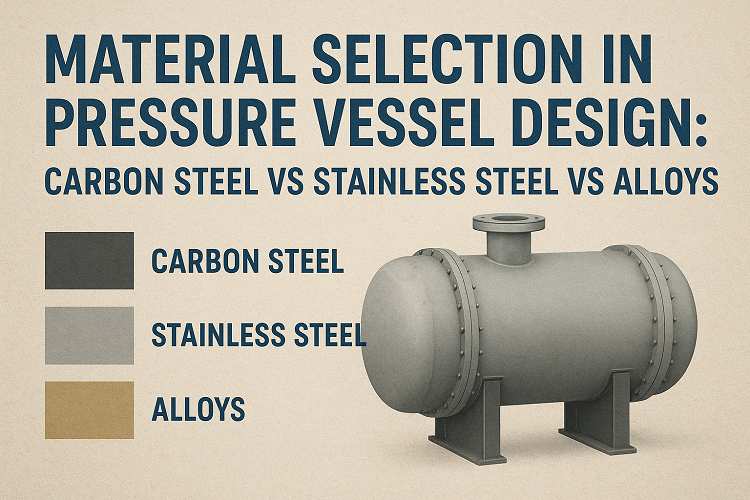
In this article, we’ll explore three major material categories – carbon steel, stainless steel and high-performance alloys – compare their strengths and limitations, and show how to make the right choice for your Pressure Vessel Design service project.
Understanding the Role of Material Selection in Pressure Vessel Design
Before diving into material types, it helps to understand the major factors that determine material selection in a pressure-vessel design. These include:
- Design pressure and operating temperature: Higher pressure or elevated temperature means you need higher strength, better creep resistance etc.
- Corrosive or aggressive environments: If the vessel contains corrosive media (acidic, chlorides, hydrogen sulfide) or sits in a harsh environment, corrosion resistance becomes paramount.
- Fabrication, weldability, inspection and maintenance: A good material must allow reliable welding, easy manufacturing, and predictable inspection regimes.
- Lifecycle cost and sustainability: It is not just upfront cost; maintenance, downtime, inspection, replacement all count. One article points out that selecting a corrosion-resistant material can reduce maintenance and extend life, thus reducing total cost.
- Compliance with codes & standards: Materials must meet applicable industry codes (for example, ASME BPVC Section VIII) and project-specific standards.
- In short, for your Pressure Vessel Design solution, it’s essential to balance performance, durability and cost. With that in mind, let’s compare the three major material categories.
Carbon Steel — The Cost-Effective Workhorse
What it is & where it’s used
Carbon steel (for example ASTM A516 Gr 70, ASTM A285, etc) is still the most commonly used material for many pressure vessels, especially those operating in non-severe conditions.
Advantages
- Relatively low cost, good availability globally.
- Good mechanical strength and weldability, making it favourable for routine vessel fabrication.
- For many applications (moderate pressure, moderate temperature, benign fluid) carbon steel is sufficient.
Limitations
- Susceptible to corrosion if the media or environment is aggressive; thus may require coatings, liners, corrosion allowance.
- At elevated temperatures or in cyclic loading/fatigue conditions, carbon steel may not offer sufficient creep or fatigue resistance compared to alloys.
- For projects where inspection/maintenance access is hard (offshore, remote), the lifecycle cost of dealing with corrosion may outweigh upfront savings.
Application note
If you are offering a Pressure Vessel Design service for a client whose vessel operates at moderate temperature (< ~300 °C) and with non-corrosive fluid (e.g., air, water, simple gas), carbon steel may be the rational choice. But always factor in corrosion allowance, inspection regime, and the possibility of future media changes.
Stainless Steel — The Corrosion-Resistant Performer
What it is & common grades
Stainless steels (e.g., 304, 316, duplex grades) bring significantly improved corrosion and oxidation resistance compared to plain carbon steel. According to a technical article, mechanical strength and corrosion resistance are among key criteria when selecting vessel materials.
Advantages
- Excellent resistance to corrosion (especially in chemical, food, pharmaceutical or marine environments).
- Better durability and lower maintenance in aggressive conditions. For example, one engineer noted that switching to corrosion-resistant material reduced downtime and maintenance.
- Often acceptable for higher temperatures than typical carbon steel in corrosive media.
Limitations
- The upfront cost is higher compared to carbon steel—material cost, fabrication (weldability may be more challenging), special inspection may be needed.
- Although corrosion resistance is high, stainless steel is not invincible: e.g., under chloride exposure, austenitic stainless may face stress corrosion cracking.
- Specifications may require more stringent fabrication controls or qualified welders.
Application note
For a Pressure Vessel Design solution in chemical processing, marine, offshore or food/pharma sectors where corrosion or hygiene is a concern, stainless steel is often worth the investment. When you are offering your Pressure Vessel Design service in such industries, emphasise how stainless steel delivers lower maintenance cost and longer service life.
Alloy Steels & Special Materials — For Extreme Conditions
What these are
High-performance alloys (for example chrome-moly steels, nickel-based alloys like Inconel/Hastelloy, titanium) are used when operating conditions are extreme (very high temperature, very high pressure, corrosive/erosive media, severe cyclic loads).
Advantages
- Outstanding strength at elevated temperature, excellent creep and fatigue resistance.
- Superb corrosion/erosion/toughness performance in harsh environments.
- When only the best will do (e.g., power plant, offshore oil & gas, hydrogen service) these materials are often mandated.
Limitations
- Very high material and fabrication cost (e.g., price of alloy plate, qualified welders, special inspection).
- Availability may be limited; lead times longer.
- Fabrication may require special procedures, post‐weld heat treatment (PWHT), and maintenance cost may still be significant.
Application note
In your Pressure Vessel Design service portfolio, when clients ask for vessels for high temperature (> 400–500 °C), hydrogen service, or highly corrosive media (acid, seawater, chloride, high-pressure gas), then alloy steels or nickel alloys may be the right choice. Emphasise the trade-off: “higher upfront cost, lower risk, longer life”.
Comparative Summary — Quick Table
Property / Material Category | Carbon Steel | Stainless Steel | Alloy / Special Materials |
Corrosion Resistance | Low to Moderate | High | Very High |
Typical Operating Temperature | Up to ~300-350 °C (varies) | Up to ~500-600 °C (in corrosion service) | > ~500-600 °C depending on alloy |
Fabrication Ease & Cost | Easy / Low | Moderate / Medium-High | Difficult / High |
Material Cost | Low | Medium | High |
Typical Use Cases | Air-receivers, Storage tanks, non-corrosive service | Chemical vessels, food-pharma, marine service | High temperature reactors, offshore, hydrogen, extreme corrosion |
Note: These are generalized ranges. Always refer to actual design codes, material specs and service conditions. |
|
|
|
Key Considerations Before Final Material Selection
When providing your Pressure Vessel Design service, you’ll want to walk your client (or design team) through these key questions:
- What is the process fluid / media? Is it corrosive (acidic, alkaline, chlorides, H₂S)? For a benign fluid you might pick carbon steel; for aggressive ones stainless or alloy.
- What are the pressure and temperature limits? High pressure or high temperature imply thicker walls or higher‐strength material (or both).
- What is the expected lifespan & maintenance regime? If downtime is costly (e.g., offshore, critical plant), invest more upfront for lower maintenance.
- What fabrication / welding / inspection constraints exist? Some alloy materials require special welding, post‐weld heat treatment (PWHT) or strict inspection regimes.
- What codes/standards apply? For pressure vessels you must ensure compliance with the relevant standard (ASME BPVC Section VIII, PD 5500, EN 13445 etc) and that the material is permitted under those codes.
- What is the total lifecycle cost? Upfront material cost is only part of the picture — factor in fabrication cost, inspection, maintenance, downtime, replacement.
- Is sustainability or weight a factor? Some newer duplex/lower weight alloys may yield thinner walls or reduced weight—helpful in transport/installation contexts.
By systematically evaluating these factors, you can support your client in choosing the optimal material for their specific service—thereby strengthening your value as a Pressure Vessel Design solution provider.
Conclusion
In summary:
- Carbon steel remains a strong choice for many standard vessels with non-aggressive service and moderate conditions—but it is not a universal solution.
- Stainless steel offers significantly better corrosion resistance and durability, making it ideal for chemical, food, marine or aggressive services—even though it costs more upfront.
- Alloy steels and high-performance materials are tailored for extreme pressure/temperature/corrosive situations—but their use must be justified by the service demands and lifecycle cost.
As a provider of Pressure Vessel Design service, your role is to guide clients through this decision framework, justify material choices based on service conditions, and link them clearly to cost, risk and lifecycle performance. In doing so, you deliver a robust, compliant, efficient design that adds real value.
At Neocent Engineering Pvt Ltd, our team offers comprehensive Pressure Vessel Design solutions—including material selection, FEA/FEA validation, code compliance review and manufacturing support—to ensure your vessel is engineered for reliable, economic service life.
Frequently Asked Questions (FAQs)
1. What factors should I consider when choosing a material for pressure vessel design?
When selecting material for a pressure vessel, you should consider several factors such as design pressure, temperature, corrosion resistance, fabrication method, and applicable codes like ASME BPVC Section VIII. The right material choice ensures safety, durability, and compliance. Consulting an experienced Pressure Vessel Design service provider like Neocent Engineering can help ensure these parameters are properly evaluated.
2. Why is carbon steel the most commonly used material in pressure vessel fabrication?
Carbon steel remains popular because it is cost-effective, readily available, and easy to fabricate. For moderate temperature and non-corrosive service, it offers reliable performance. However, when vessels operate in aggressive or high-temperature environments, alternatives like stainless steel or alloy steel are preferred for better corrosion and heat resistance.
3. How do stainless steel and alloy steels differ in pressure vessel applications?
Stainless steel offers excellent corrosion resistance, making it ideal for chemical, marine, and food industries. Alloy steels, on the other hand, are designed for extreme conditions — high temperatures, pressures, or corrosive environments. In general, stainless steels focus on corrosion resistance, while alloy steels emphasize strength and durability under extreme loads.
4. How does material selection affect the lifecycle cost of a pressure vessel?
Although materials like stainless or alloy steel may cost more initially, they often reduce long-term maintenance and downtime. Studies show that selecting corrosion-resistant materials can lower maintenance costs by up to 35% over the equipment lifecycle (Outokumpu, 2025). This makes material selection a crucial step in developing cost-effective Pressure Vessel Design solutions.
5. Can computational tools like FEA and CFD assist in material selection for pressure vessels?
Yes. Finite Element Analysis (FEA) and Computational Fluid Dynamics (CFD) are increasingly used in modern Pressure Vessel Design services. FEA helps assess stress distribution and deformation under load, while CFD evaluates fluid flow, temperature, and pressure distribution. Together, they validate whether the selected material can safely handle operational stresses before manufacturing begins.
6. Why should I consult a professional engineering company for pressure vessel material selection?
Material selection is not just about cost — it involves code compliance, mechanical integrity, and long-term safety. Professional firms like Neocent Engineering Pvt. Ltd. provide end-to-end Pressure Vessel Design solutions, including material evaluation, code-based analysis, and fabrication support. Their expertise ensures your design meets performance, safety, and cost objectives efficiently.

Krupal Patel
Krupal Patel is the CEO of Neocent Engineering Pvt. Ltd., Ahmedabad, specializing in advanced engineering solutions. With over 8 years of expertise in Product Design, FEA, CFD, and ASME-BPVC stress analysis, he has successfully delivered high-precision projects across pressure vessels, piping, and structural systems.