
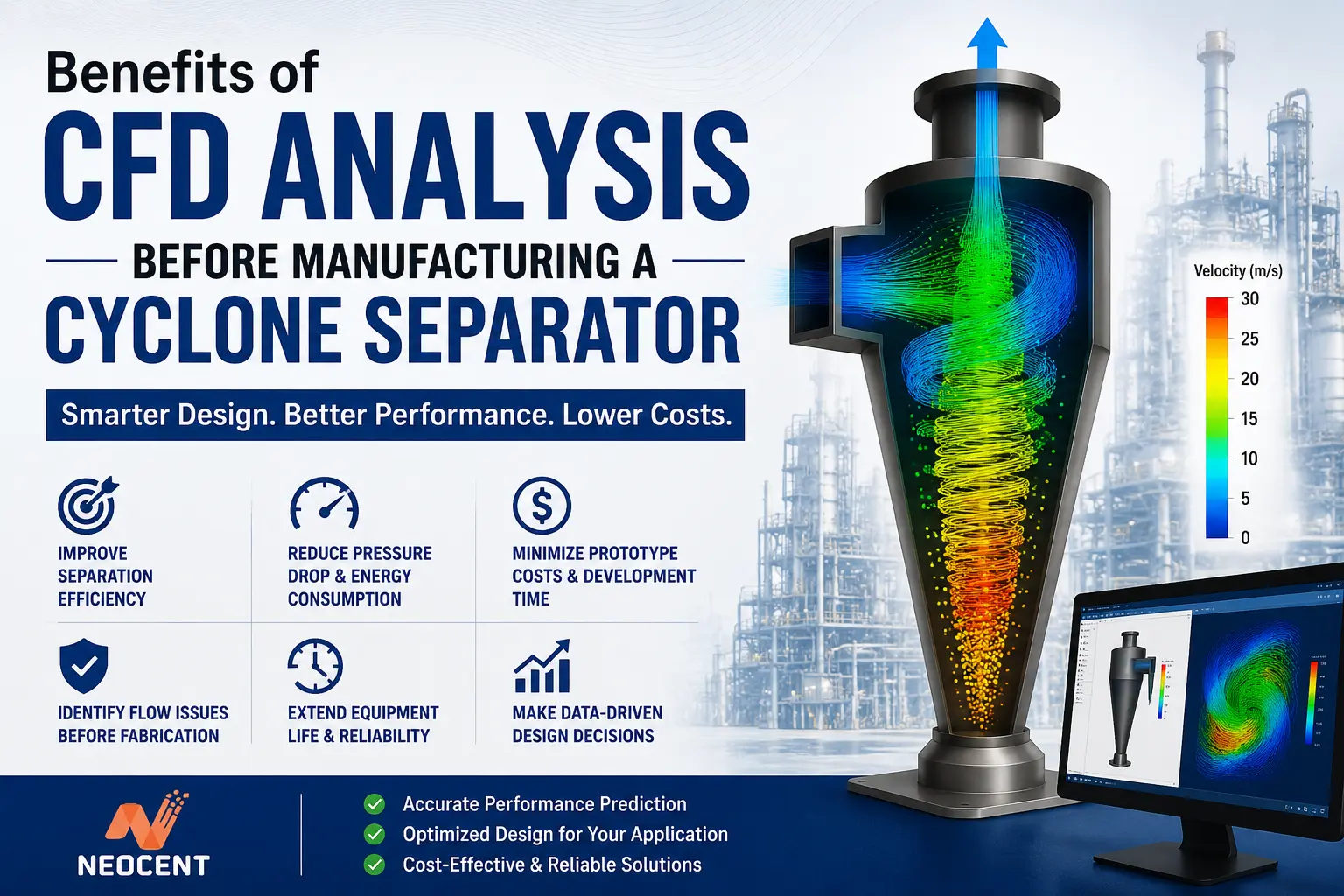
In industries such as cement, chemical processing, mining, pharmaceuticals, power generation, and food processing, cyclone separators play a critical role in dust collection and particle separation. The efficiency of a cyclone separator directly impacts operational costs, energy consumption, equipment life, and environmental compliance. However, relying solely on traditional design methods or physical prototypes can lead to performance issues that are expensive to fix after manufacturing.
This is where Computational Fluid Dynamics Engineering Services become invaluable. By conducting a detailed simulation before fabrication, engineers can predict airflow patterns, pressure drops, turbulence, and particle trajectories under real operating conditions. As a result, manufacturers can optimize designs, reduce development costs, and improve the overall reliability of the final product.
In this article, we will explore the key benefits of CFD analysis before manufacturing a cyclone separator and why industries increasingly rely on professional CFD consulting services to validate and optimize their designs.
What Is CFD Analysis?
Computational Fluid Dynamics (CFD) is a branch of engineering that uses numerical methods and advanced computer simulations to study the behavior of fluids and gases. CFD enables engineers to visualize and analyze complex flow phenomena that are difficult or impossible to observe through physical testing alone.
For cyclone separators, CFD analysis can simulate:
- Airflow velocity and distribution
- Particle movement and separation efficiency
- Pressure drop across the separator
- Turbulence and vortex formation
- Areas of erosion and wear
- Flow recirculation and dead zones
With modern CFD Consulting & Analysis Services in India, industries can identify potential design issues early in the development stage and make data-driven improvements before investing in manufacturing.
Why Perform CFD Analysis Before Manufacturing?
Manufacturing a cyclone separator without prior simulation often requires multiple design iterations and costly physical testing. If performance problems are discovered after fabrication, modifications may involve redesigning internal components or even replacing the entire unit.
A professional cyclone separator CFD engineering service helps engineers evaluate and optimize the design virtually, reducing uncertainty and improving confidence in the final product.
Optimize Separation Efficiency
The primary objective of a cyclone separator is to maximize particle collection while maintaining smooth airflow. Small changes in the inlet geometry, cone angle, vortex finder dimensions, or outlet configuration can significantly affect separation efficiency.
CFD simulations allow engineers to study particle trajectories and determine how effectively particles of different sizes are captured. By analyzing these flow patterns, designers can optimize the separator geometry for improved collection performance without relying on trial-and-error methods.
This results in a more efficient product that meets operational requirements from the very first manufactured unit.
Reduce Pressure Drop and Energy Consumption
Pressure drop is one of the most important performance parameters of a cyclone separator. Excessive pressure loss increases the power required by fans and blowers, leading to higher operating costs over the equipment’s lifetime.
Using CFD consulting, engineers can accurately predict pressure losses across the cyclone and identify design modifications that minimize resistance while maintaining separation efficiency. Optimizing the balance between collection performance and energy consumption helps industries reduce long-term operational expenses.
For facilities running continuous production processes, even a small reduction in pressure drop can translate into substantial annual energy savings.
Minimize Prototype Development Costs
Traditional product development often involves manufacturing multiple physical prototypes to evaluate performance. Each design iteration requires additional material, labor, testing time, and engineering resources.
With Computational Fluid Dynamics Engineering Services, multiple design concepts can be evaluated virtually before fabrication. Engineers can compare different inlet configurations, cone dimensions, and outlet geometries through simulation, selecting the most efficient design before committing to manufacturing.
By reducing the number of physical prototypes required, companies can lower development costs and accelerate project timelines.
Identify Flow Problems Before Fabrication
Flow instabilities such as recirculation zones, uneven velocity distribution, and excessive turbulence can reduce cyclone performance and increase maintenance requirements. Detecting these issues after installation often results in expensive modifications and production downtime.
CFD analysis provides detailed visualizations of internal flow behavior, helping engineers identify:
- Dead zones that reduce separation efficiency.
- High-velocity regions that may cause erosion.
- Unstable vortex formation affecting particle collection.
- Air leakage or flow imbalance problems.
Early detection enables corrective action during the design phase, preventing costly manufacturing and operational issues later.
Improve Equipment Life and Reliability
Cyclone separators frequently handle abrasive particles that can cause significant wear on internal surfaces. Areas exposed to high particle impact velocities are particularly vulnerable to erosion, which can shorten equipment life and increase maintenance costs.
A specialized cyclone separator CFD engineering service can predict particle impact locations and erosion-prone regions within the equipment. Engineers can then optimize the design or recommend wear-resistant materials and protective liners for critical areas.
This proactive approach extends equipment lifespan, reduces maintenance frequency, and improves overall plant reliability.
Accelerate Product Development and Time to Market
In competitive industries, reducing product development time provides a significant business advantage. Waiting for physical testing and multiple prototype revisions can delay project schedules and increase costs.
CFD simulation enables engineers to evaluate multiple design alternatives simultaneously, rapidly validating concepts and making informed design decisions. By integrating CFD Consulting & Analysis Services in India into the engineering workflow, manufacturers can shorten design cycles and bring optimized products to market faster.
This speed is particularly valuable for custom-engineered cyclone separators designed for unique industrial applications.
Support Custom and Industry-Specific Designs
Every industrial process has unique operating conditions, including variations in flow rate, particle size distribution, gas properties, and temperature. A one-size-fits-all cyclone separator design may not deliver optimal performance across different applications.
CFD analysis allows engineers to customize designs based on actual operating data. Whether the separator is intended for a cement plant, chemical processing facility, pharmaceutical production line, or power generation application, simulation ensures that the final design is tailored to the specific process requirements.
This customized engineering approach enhances both operational efficiency and customer satisfaction.
Improve Decision-Making with Engineering Insights
One of the greatest advantages of CFD consulting is the ability to make engineering decisions based on quantitative data rather than assumptions. CFD reports provide detailed information about velocity contours, pressure distributions, turbulence intensity, and particle movement throughout the cyclone separator.
These engineering insights help project teams:
- Compare multiple design options.
- Validate design modifications.
- Reduce technical risks.
- Support client approvals and project documentation.
- Improve confidence before manufacturing.
The result is a more robust design process backed by simulation-driven evidence.
Why Choose Professional CFD Consulting Services?
While CFD software has become more accessible, obtaining accurate and reliable simulation results requires expertise in fluid mechanics, turbulence modeling, mesh generation, boundary condition setup, and result interpretation. An inaccurate model can lead to misleading conclusions and poor design decisions.
Working with an experienced provider of Computational Fluid Dynamics Engineering Services ensures that simulations reflect real-world operating conditions and deliver practical engineering recommendations. Professional CFD Consulting & Analysis Services in India combine advanced simulation tools with industry-specific engineering knowledge to help manufacturers optimize product performance and reduce development risks.
From concept validation to design optimization and final performance verification, CFD experts support every stage of the engineering lifecycle.
Conclusion
CFD analysis has become an essential part of modern cyclone separator development. By simulating real operating conditions before manufacturing, companies can optimize separation efficiency, reduce pressure drop, lower energy consumption, minimize prototype costs, and improve equipment reliability.
A comprehensive cyclone separator CFD engineering service provides engineers with valuable insights into airflow behavior and particle dynamics, enabling smarter design decisions and reducing the need for expensive trial-and-error development. In today’s competitive industrial environment, investing in professional CFD consulting is not just a technical advantage—it is a strategic decision that improves product quality, reduces project risks, and accelerates product development.
At Neocent Engineering, we deliver advanced Computational Fluid Dynamics Engineering Services and CFD Consulting & Analysis Services in India to help industries design and optimize high-performance cyclone separators and other process equipment. Our engineering team leverages simulation-driven insights to validate designs, improve operational efficiency, and ensure manufacturing-ready solutions tailored to your application requirements.
If your organization is developing or upgrading cyclone separators for industrial applications, partnering with Neocent Engineering can help you achieve a cost-effective, reliable, and high-performance design with greater confidence.
Frequently Asked Questions (FAQs)
What is CFD analysis in cyclone separator design?
CFD analysis is a computer-based simulation method used to study airflow, particle movement, and pressure distribution to optimize cyclone separator performance before manufacturing.Why is CFD analysis important before manufacturing a cyclone separator?
CFD helps identify design issues early, improving separation efficiency, reducing pressure drop, and minimizing costly design changes after fabrication.How does CFD consulting help reduce development costs?
CFD consulting enables virtual testing of multiple design options, reducing the need for expensive physical prototypes and repeated trial-and-error testing.Which industries benefit from cyclone separator CFD engineering services?
Industries such as cement, chemical processing, pharmaceuticals, mining, power generation, and food processing commonly use CFD-optimized cyclone separators.Why choose Neocent Engineering for CFD Consulting & Analysis Services in India?
Neocent Engineering provides advanced CFD consulting and simulation services to optimize cyclone separator designs, improve performance, and deliver manufacturing-ready engineering solutions.

Krupal Patel
Krupal Patel is the CEO of Neocent Engineering Pvt. Ltd., Ahmedabad, specializing in advanced engineering solutions. With over 8 years of expertise in Product Design, FEA, CFD, and ASME-BPVC stress analysis, he has successfully delivered high-precision projects across pressure vessels, piping, and structural systems.