
In today’s competitive engineering landscape, especially in heavy industries like oil & gas, power generation, and chemical processing, structural design demands precision, speed, and reliability. Traditional Finite Element Analysis (FEA) has long been the gold standard for validating structural integrity, but it often comes with challenges: lengthy computation times, mesh dependency errors, and the need for expert manual intervention.
Enter Artificial Intelligence (AI) – a transformative force that’s revolutionizing FEA workflows. By integrating machine learning and deep learning techniques, engineers can now achieve faster simulations, minimize human-induced errors, and deliver more accurate results. As a premier FEA service in India, Neocent Engineering is at the forefront of adopting these AI-powered advancements to help clients optimize designs efficiently while ensuring compliance with global standards like ASME, AISC, and IS codes.
Here’s how AI in FEA is reshaping structural design in 2026.
Why Traditional FEA Needs AI: Common Pain Points
Finite Element Analysis involves discretizing complex geometries into meshes, applying loads/boundary conditions, and solving large systems of equations. While powerful, it faces limitations:
- High computational time – Complex nonlinear models can take hours or days.
- Error-prone setup – Poor meshing, incorrect boundary conditions, or material assumptions lead to inaccurate results.
- Expert dependency – Skilled analysts are required for convergence studies and validation.
AI addresses these by automating repetitive tasks, predicting outcomes, and enhancing accuracy — delivering FEA consulting in India that’s faster and more reliable.
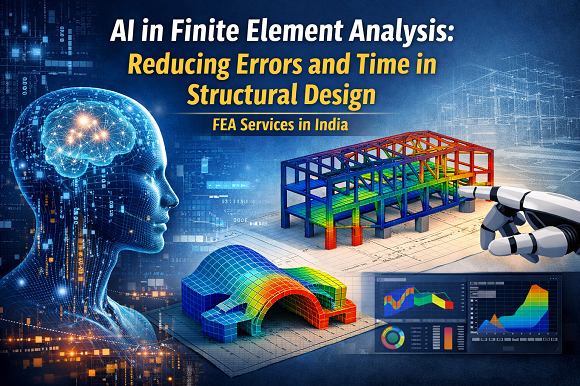
Here are some visualizations of AI-augmented FEA processes:
Key Ways AI Reduces Errors and Time in FEA
1. AI-Powered Mesh Generation and Optimization
Traditional meshing is manual and time-intensive. AI algorithms (e.g., neural networks) automatically generate high-quality meshes, adaptively refine critical areas, and predict convergence issues before solving.
Benefits:
- Up to 50-70% reduction in preprocessing time.
- Fewer mesh-related errors, leading to more reliable stress/strain predictions.
2. Surrogate Models and Reduced-Order Modeling (ROM)
Machine learning surrogate models train on existing FEA data to predict results instantly for new designs. This replaces full simulations for parametric studies or optimization loops.
Real-world impact:
- Orders-of-magnitude faster iterations (100x in some cases).
- Ideal for design exploration in structural steel or pressure vessel components.
3. Error Detection and Predictive Validation
AI analyzes historical simulation data to flag anomalies, suggest corrections to boundary conditions, and predict potential failure modes. Deep learning models can even estimate stress distributions with minimal error (often <3%).
This proactive approach significantly cuts rework in structural design projects.
4. Generative Design and Optimization
AI-driven generative tools explore thousands of design variants, optimizing for weight, strength, and cost while respecting constraints. Combined with FEA, this accelerates innovation in heavy engineering.
Real-World Benefits for Indian Engineering Projects
In India’s growing manufacturing and energy sectors, adopting AI in FEA translates to tangible gains:
- Faster Time-to-Market – Reduce simulation cycles from weeks to days.
- Cost Savings – Fewer physical prototypes and iterations.
- Improved Accuracy & Compliance – Better handling of nonlinearities, fatigue, and dynamic loads.
- Sustainability – Optimized material usage aligns with green engineering goals.
At Neocent Engineering, our FEA services in India leverage these AI tools for clients in oil & gas, power plants, and chemical industries – ensuring robust, code-compliant designs.
Challenges and Best Practices When Implementing AI in FEA
While promising, AI integration requires:
- High-quality training data from validated FEA runs.
- Hybrid approaches (physics-informed neural networks) to maintain accuracy.
- Validation against physical tests.
Best practice: Start with surrogate models for routine analyses, then scale to full AI-enhanced workflows.
The Future of AI-Powered FEA in India
As we move further into 2026, expect deeper integration of AI in Finite Element Analysis – from real-time simulations to autonomous design agents. Indian engineering firms adopting these technologies early will gain a competitive edge globally.
Neocent Engineering, a trusted FEA consulting India provider since 2019, combines advanced AI with expert structural analysis to deliver precise, efficient solutions. Whether you’re designing pressure vessels, skids, or structural steel, our team helps reduce errors, save time, and future-proof your projects.
Ready to experience AI-enhanced FEA? Contact Neocent Engineering today for a free consultation on our FEA services in India.
Frequently Asked Questions (FAQs)
1. What is AI in Finite Element Analysis (FEA)?
AI in FEA uses machine learning, neural networks, and surrogate models to automate meshing, predict results, detect errors, and speed up simulations — making traditional FEA faster and more accurate.
2. How much time can AI save in FEA simulations?
AI can reduce preprocessing and solving time by 50-90% (e.g., through automated meshing and surrogate models), turning days-long runs into hours or minutes for repetitive or parametric studies.
3. Does AI replace human engineers in FEA?
No. AI acts as a powerful assistant — it handles repetitive tasks, suggests optimizations, and flags errors — but expert engineers are still essential for setup, validation, compliance (ASME, IS codes), and final interpretation.
4. Is AI-powered FEA accurate enough for critical structural designs?
Yes, when properly trained on high-quality data and combined with physics-informed models. Many AI tools achieve errors below 3-5% compared to full FEA, and they are validated against real tests for industries like oil & gas and pressure vessels.
5. How can Indian companies benefit from AI-enhanced FEA services?
Indian firms gain faster design iterations, lower prototyping costs, better compliance, and competitive advantage in global projects. Providers like Neocent Engineering offer expert FEA consulting in India that integrates AI tools for structural, piping, and equipment design.

Krupal Patel
Krupal Patel is the CEO of Neocent Engineering Pvt. Ltd., Ahmedabad, specializing in advanced engineering solutions. With over 8 years of expertise in Product Design, FEA, CFD, and ASME-BPVC stress analysis, he has successfully delivered high-precision projects across pressure vessels, piping, and structural systems.