
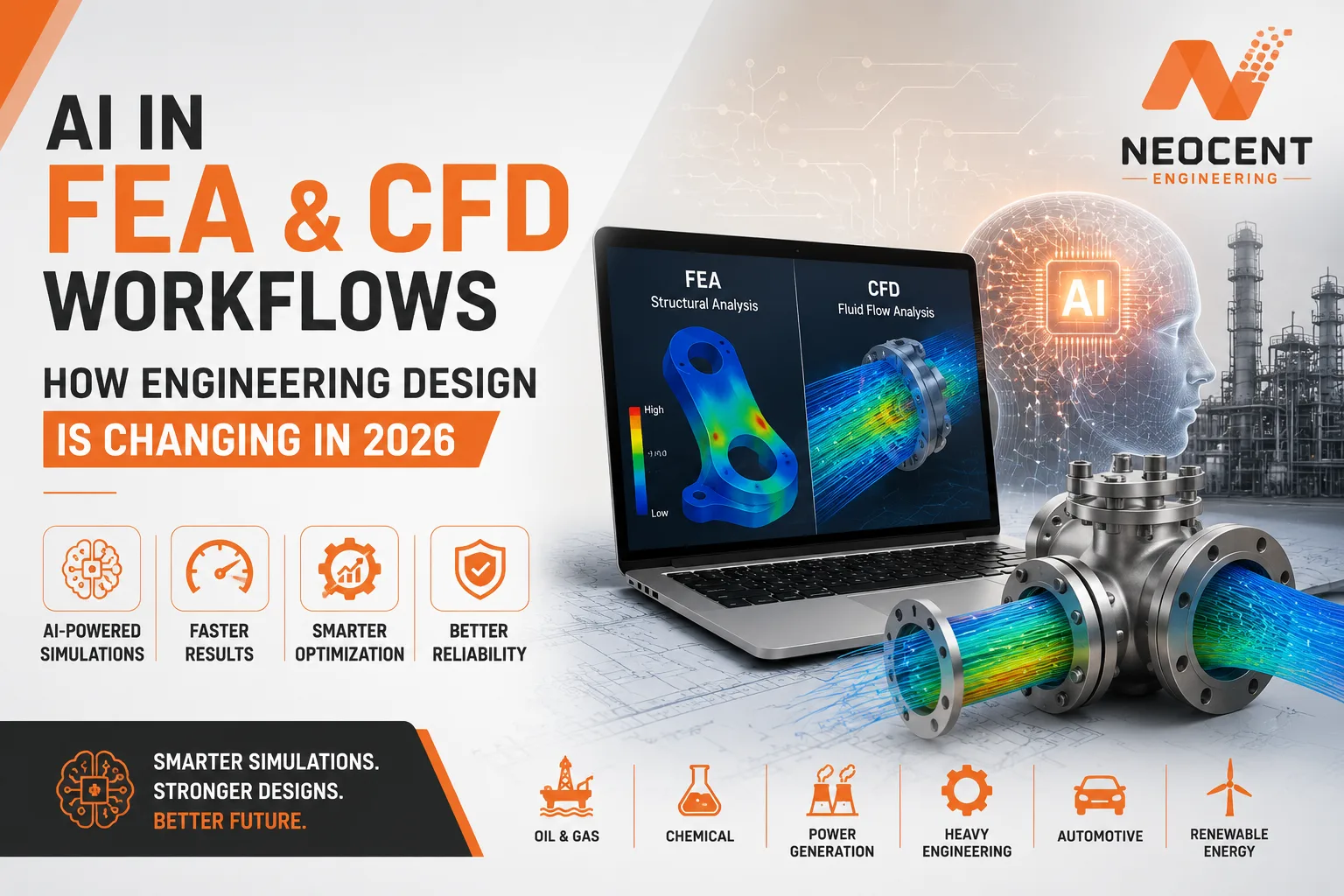
Engineering design has evolved significantly over the past decade, and 2026 marks a major shift in how products, industrial equipment, and process systems are developed. Artificial Intelligence (AI) is no longer just a futuristic concept – it has become an essential tool that complements traditional engineering simulation. When combined with Finite Element Analysis (FEA) and Computational Fluid Dynamics (CFD), AI helps engineers make faster, more accurate, and data-driven design decisions.
Industries such as oil & gas, power generation, chemical processing, renewable energy, heavy equipment manufacturing, automotive, and aerospace are increasingly adopting AI-powered simulation workflows to reduce development time, improve product quality, and minimize costly design iterations.
In this article, we’ll explore how AI is transforming FEA and CFD workflows, the benefits for engineering organizations, and why simulation-driven design is becoming the new industry standard.
Understanding FEA and CFD
Before discussing AI integration, it’s important to understand these two core engineering simulation methods.
Finite Element Analysis (FEA) is used to evaluate how components or structures respond to loads, pressure, vibration, thermal effects, and other real-world operating conditions. It enables engineers to identify stress concentrations, deformation, fatigue issues, and potential failure points before manufacturing begins.
Computational Fluid Dynamics (CFD) analyzes the movement of fluids, gases, heat transfer, pressure distribution, and turbulence within equipment and piping systems. It helps optimize flow performance and improve thermal efficiency while reducing energy losses.
Together, FEA and CFD help engineers validate designs virtually, reducing the need for expensive physical prototypes.
Why AI is Becoming Essential in Engineering Design
Traditional simulation workflows often require engineers to manually prepare geometry, generate meshes, define material properties, apply loads, review results, and repeat the process until an optimized design is achieved.
AI significantly improves this workflow by automating repetitive tasks, identifying design improvements, and accelerating simulation cycles.
Key advantages include:
- Faster simulation setup
- Automated mesh generation
- Intelligent design optimization
- Improved prediction accuracy
- Reduced engineering effort
- Faster product development
- Better resource utilization
- Lower development costs
Rather than replacing engineers, AI acts as an intelligent assistant that enhances productivity and allows engineers to focus on solving complex engineering challenges.
How AI Improves FEA Workflows
Faster Design Optimization
AI can evaluate thousands of design alternatives within a short time. Instead of manually modifying CAD models, engineers receive optimized geometry suggestions based on design objectives such as reduced weight, increased strength, or lower material consumption.
This dramatically shortens product development cycles.
Smart Mesh Generation
Mesh quality directly affects simulation accuracy.
AI-assisted meshing tools automatically detect complex regions, apply local mesh refinement, and minimize poor-quality elements, reducing pre-processing time while maintaining high accuracy.
Predictive Failure Analysis
Historical simulation data combined with machine learning allows engineers to predict failure locations before running a full simulation.
This helps prioritize design improvements and reduces unnecessary simulation iterations.
Material Selection Assistance
AI analyses material databases and recommends suitable materials based on:
- Strength requirements
- Temperature resistance
- Corrosion resistance
- Manufacturing process
- Cost targets
This enables better engineering decisions during the early design stages.
How AI is Transforming CFD Workflows
Automated Flow Optimization
AI can quickly evaluate multiple flow paths and suggest optimized geometries for improved fluid performance.
Applications include:
- Heat exchangers
- Pumps
- Pressure vessels
- Separators
- Pipelines
- Mixing systems
- HVAC equipment
Improved flow characteristics result in better efficiency and lower operating costs.
Reduced Simulation Time
Traditional CFD simulations can take several hours or even days.
AI-assisted models learn from previous simulations and estimate flow behavior much faster, allowing engineers to evaluate design concepts in less time.
Thermal Performance Prediction
AI improves thermal analysis by identifying heat concentration zones and recommending design modifications to enhance cooling efficiency.
Industries including electronics, battery systems, and process equipment benefit significantly from these capabilities.
Industries Benefiting from AI-Driven Simulation
AI-powered engineering simulations are creating value across multiple industries.
Oil & Gas
- Pressure vessel optimization
- Separator design
- Piping stress validation
- Offshore structural analysis
Power Generation
- Heat exchanger optimization
- Boiler component analysis
- Steam flow simulation
- Turbine cooling studies
Chemical Processing
- Reactor design
- Mixing performance
- Fluid distribution
- Pressure loss reduction
Heavy Engineering
- Structural validation
- Lifting equipment analysis
- Skid package design
- Storage tank assessment
Automotive
- Lightweight components
- Crash analysis
- Thermal management
- Aerodynamic optimization
Benefits of AI-Powered Engineering Simulation
Organizations adopting AI-assisted simulation experience measurable improvements.
Shorter Development Time
AI automates repetitive engineering tasks, allowing projects to move from concept to production much faster.
Improved Design Accuracy
Machine learning models help identify potential design weaknesses earlier, reducing costly redesigns.
Lower Engineering Costs
Virtual validation reduces dependence on multiple physical prototypes, resulting in significant cost savings.
Better Product Reliability
Engineers can evaluate more operating conditions and optimize designs before manufacturing begins.
Improved Decision Making
AI provides data-driven insights that support better engineering decisions throughout the design lifecycle.
Why Expert Engineering Knowledge Still Matters
Despite rapid advancements in AI, engineering expertise remains essential.
AI cannot independently interpret design codes, regulatory requirements, or project-specific constraints. Experienced engineers are still responsible for:
- Understanding design intent
- Applying engineering judgment
- Meeting ASME, API, ISO, and other international standards
- Validating AI-generated recommendations
- Ensuring safe and reliable equipment design
This is why businesses continue to rely on experienced FEA Expert teams and professional FEA consultant services for critical engineering projects.
Choosing the Right Engineering Partner
Implementing AI successfully requires more than advanced software. It requires experienced engineers who understand simulation methodologies, industry standards, and practical manufacturing constraints.
When selecting a partner for Finite Element Analysis Services or CFD consulting service, look for expertise in:
- Pressure vessel engineering
- Structural analysis
- Piping engineering
- Heat exchanger design
- Skid package engineering
- Static equipment design
- ASME code compliance
- Advanced CAD and simulation tools
Experienced consultants can combine AI-powered workflows with engineering expertise to deliver reliable, cost-effective solutions.
At Neocent Engineering, advanced simulation technologies are combined with industry knowledge to deliver accurate engineering solutions for clients across multiple industrial sectors. From structural validation to complex flow analysis, the team helps organizations reduce design risks, improve product performance, and accelerate project delivery.
The Future of AI in Engineering
The future of engineering design is increasingly data-driven.
Emerging technologies such as Digital Twins, generative design, cloud-based simulation, AI-assisted optimization, and real-time predictive analytics will continue to reshape how industrial equipment is designed and validated.
Organizations that embrace these technologies today will be better positioned to reduce costs, improve innovation, and stay competitive in rapidly evolving markets.
AI will not replace engineers – it will empower them to solve more complex challenges with greater speed and confidence.
Conclusion
Artificial Intelligence is transforming engineering workflows by making Finite Element Analysis Services and CFD consulting service faster, smarter, and more efficient. From automated meshing and predictive failure analysis to intelligent flow optimization and thermal performance improvements, AI enables engineering teams to deliver higher-quality designs in less time.
However, the best results come from combining AI with experienced engineering professionals who understand real-world design requirements and international standards. Whether you’re looking for an experienced FEA Expert, a trusted FEA consultant, or reliable simulation support, partnering with the right engineering team ensures accurate analysis and dependable outcomes.
Neocent Engineering leverages modern simulation technologies together with engineering expertise to help industries develop safer, more efficient, and high-performance mechanical systems that meet today’s demanding project requirements.

Krupal Patel
Krupal Patel is the CEO of Neocent Engineering Pvt. Ltd., Ahmedabad, specializing in advanced engineering solutions. With over 8 years of expertise in Product Design, FEA, CFD, and ASME-BPVC stress analysis, he has successfully delivered high-precision projects across pressure vessels, piping, and structural systems.