
Introduction
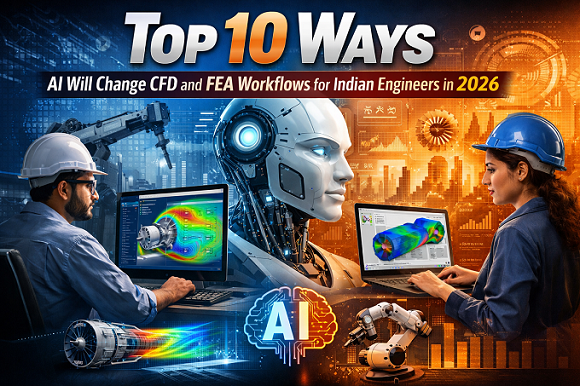
In 2026, Artificial Intelligence (AI) is no longer a futuristic concept for Indian engineers – it’s a practical game-changer reshaping Computational Fluid Dynamics (CFD) and Finite Element Analysis (FEA) workflows. As India strengthens its position in global manufacturing, oil & gas, chemical processing, and heavy engineering, tools like AI-driven surrogate models, physics-informed neural networks (PINNs), and reduced order modeling (ROM) are slashing simulation times from days to minutes while maintaining high accuracy.
At Neocent Engineering, we integrate advanced FEA and CFD with emerging AI to deliver compliant, optimized designs for pressure vessels, heat exchangers, piping, and skid packages. Here are the top 10 ways AI will transform CFD and FEA workflows for Indian engineers this year.
1. Lightning-Fast Surrogate Modeling for Instant Predictions
Traditional CFD and FEA require extensive computational resources for each iteration. AI surrogate models, trained on high-fidelity simulation data, predict outcomes in real-time.
For Indian engineers handling complex heat exchanger designs or turbulent flows in oil & gas, this means exploring hundreds of design variations instantly – reducing project timelines by 80-90%. Tools like Neural Concept and Ansys-integrated AI exemplify this shift.
2. Automated Mesh Generation and Optimization
Meshing remains a major bottleneck in FEA and CFD. AI automates adaptive meshing, focusing refinement on high-stress or high-gradient zones while minimizing elements elsewhere.
In 2026, AI-powered tools in platforms like Altair HyperMesh and SimScale generate optimal meshes with minimal user input, cutting setup time dramatically for Indian teams working on structural steel or pressure vessel compliance (ASME, EN standards).
3. Physics-Informed Neural Networks (PINNs) for Complex Physics
PINNs embed governing equations (Navier-Stokes for CFD, elasticity for FEA) directly into neural networks, enabling accurate simulations with less data and no traditional meshing.
This hybrid approach excels in multiphase flows, turbulence modeling, and nonlinear FEA – ideal for Indian chemical processing plants optimizing fluid flow and heat transfer.
4. Reduced Order Modeling (ROM) for Accelerated Iterations
ROM creates compact, low-dimensional models from full-order simulations, balancing speed and fidelity.
With GPU acceleration and AI, ROMs now deliver near-real-time results for large-scale analyses like skid package optimization or aerodynamic simulations – empowering cost-conscious Indian manufacturers to iterate faster.
5. Generative AI for Design Exploration and Optimization
Generative design uses AI to explore thousands of geometry options based on constraints (stress, flow, weight, cost).
In heat exchanger and piping design, generative AI suggests innovative, compliant configurations that traditional methods miss – accelerating innovation in India’s power generation and water treatment sectors.
6. Predictive Turbulence and Flow Modeling
AI enhances turbulence models (RANS, LES) by learning from high-fidelity data, predicting complex behaviors like separation or vortex shedding more accurately.
For Indian aerospace and automotive engineers adopting CFD, AI reduces reliance on empirical constants, improving prediction reliability in real-world applications.
7. AI-Driven Error Detection and Convergence Monitoring
AI agents monitor simulations in real-time, adjusting timesteps, relaxation factors, or detecting non-convergence early.
This quality-of-life improvement minimizes failed runs and rework – crucial for resource-limited Indian engineering teams running cloud-based FEA/CFD.
8. End-to-End Agentic AI Workflows (e.g., FeaGPT)
Emerging tools like FeaGPT enable conversational interfaces: input specs in natural language, and AI handles geometry creation, meshing, simulation, and analysis.
This democratizes advanced simulations for non-experts in Indian SMEs, streamlining pressure vessel or structural design compliance.
9. Integration with Cloud HPC and GPU Acceleration
AI thrives on massive datasets; cloud platforms (AWS, Azure, Rescale with NVIDIA) provide scalable GPU resources for training AI models on CFD/FEA data.
Indian firms gain access to enterprise-grade tools without heavy infrastructure investments—aligning with India’s growing AI ecosystem (e.g., Made-in-India models like BrahmAI for engineering simulations).
10. Enhanced Predictive Maintenance and Digital Twins
AI combines FEA/CFD with IoT data to create digital twins for real-time performance prediction and failure forecasting.
In manufacturing and power plants, this extends equipment life and reduces downtime – vital for India’s industrial resilience.
Conclusion
By 2026, AI will make CFD and FEA faster, smarter, and more accessible for Indian engineers. From surrogate models accelerating iterations to generative AI fostering innovation, these advancements position firms like Neocent Engineering to deliver superior, compliant solutions in pressure vessel design, heat exchangers, piping, and beyond.
Embracing AI isn’t optional – it’s essential for staying competitive in global markets. Ready to transform your workflows? Contact Neocent Engineering for AI-integrated FEA, CFD, and design consulting tailored to Indian industries.
FAQ Section
1. What is the biggest benefit of AI in CFD and FEA for Indian engineers?
AI dramatically reduces simulation time – from days/hours to minutes—through surrogate models, PINNs, and automated meshing, allowing faster design iterations for pressure vessels, heat exchangers, and piping while keeping costs low.
2. Do I need to be an AI expert to use these tools in 2026?
No. Tools like Ansys SimAI, Altair, and cloud platforms (SimScale, Rescale) offer user-friendly interfaces, no-code options, and conversational AI (e.g., FeaGPT) that handle meshing, solving, and analysis automatically.
3. Will AI replace traditional FEA/CFD solvers completely?
Not fully – AI acts as a powerful accelerator (surrogate/ROM for quick predictions) and complement (PINNs for complex physics), but high-fidelity traditional solvers remain essential for final validation and compliance (ASME, API, EN standards).
4. Is AI in CFD/FEA accessible for small and medium Indian engineering firms?
Yes. Cloud-based platforms provide scalable GPU resources without heavy hardware investment. Indian firms can start with subscription models and train AI on their own legacy data for customized, fast results.
5. How can AI help with compliance and optimization in pressure vessel or heat exchanger design?
AI enables generative design exploration (thousands of compliant options), predictive error detection, and real-time optimization of stress, flow, and materials – ensuring faster, safer, and more innovative designs compliant with global codes.

Krupal Patel
Krupal Patel is the CEO of Neocent Engineering Pvt. Ltd., Ahmedabad, specializing in advanced engineering solutions. With over 8 years of expertise in Product Design, FEA, CFD, and ASME-BPVC stress analysis, he has successfully delivered high-precision projects across pressure vessels, piping, and structural systems.