
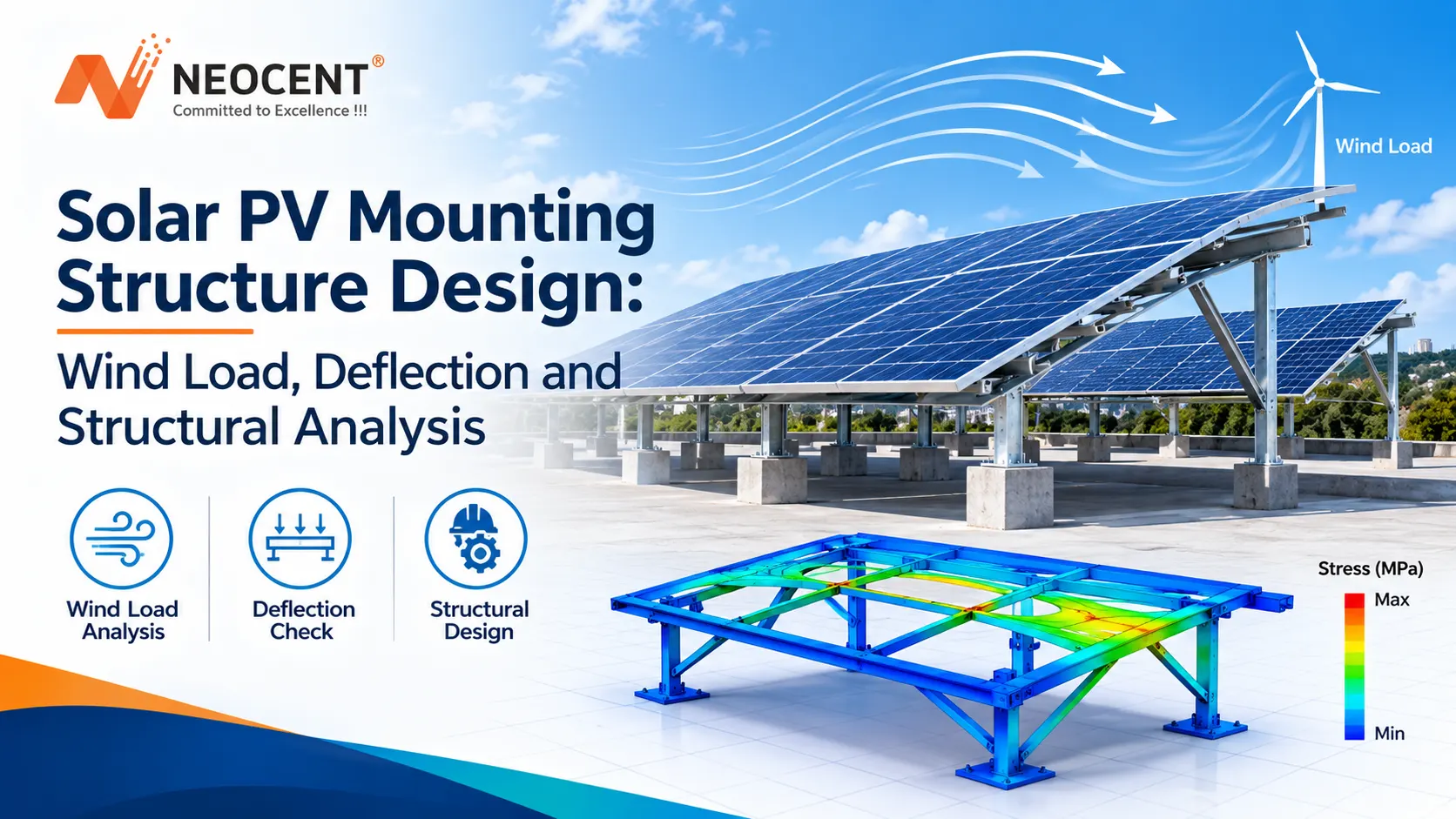
Solar energy is becoming an important part of the global renewable energy transition. As solar installations expand across residential, commercial, and utility-scale projects, the reliability of photovoltaic (PV) mounting structures becomes increasingly important. These structures support solar panels and transfer loads safely to foundations or building structures.
Solar PV mounting structure design requires careful consideration of wind loads, structural strength, deflection, material properties, and installation conditions. An inadequately designed mounting system may experience excessive deformation, connection damage, or instability under demanding environmental conditions.
Engineering calculations and finite element analysis (FEA) can help evaluate structural behavior and identify potential design concerns before fabrication and installation. This article explains the major factors involved in solar mounting structure design and how structural analysis supports reliable engineering decisions.
What Is a Solar PV Mounting Structure?
A solar PV mounting structure is a supporting framework used to install photovoltaic panels at the required orientation and inclination. It provides mechanical support, maintains panel alignment, and transfers applied loads to the supporting foundation or building structure.
Mounting systems are commonly manufactured using materials such as galvanized steel or aluminum, depending on project requirements, environmental conditions, and structural considerations.
Types of Solar PV Mounting Structures
Ground-mounted structures: Installed on foundations or piles, these systems are widely used in utility-scale solar farms.
Rooftop mounting systems: Designed for installation on existing or new buildings, these structures must consider roof capacity, attachment details, and available space.
Fixed-tilt mounting structures: Panels remain at a selected inclination throughout operation. Their design involves evaluating wind exposure and structural loading at the installed angle.
Solar tracker structures: These systems adjust panel orientation to follow the sun. Their structural design may involve additional considerations related to moving components, torsional behavior, and dynamic loading.
Each mounting configuration requires an engineering approach appropriate to its geometry, location, and operating conditions.
How Does Wind Load Affect Solar Mounting Structure Design?
Wind is one of the important environmental loads considered during solar mounting structure design. Solar panels present surfaces that can experience wind pressure and suction, creating forces that act on the supporting framework.
Depending on wind direction and installation conditions, these forces may produce uplift, lateral loading, bending moments, and torsional effects.
Key Wind Load Factors
Wind speed and project location: The design wind speed and applicable regional requirements influence the loads used for structural evaluation.
Panel tilt angle: The inclination of solar panels affects how wind interacts with their surfaces and supporting members.
Terrain and exposure: Open terrain, surrounding buildings, and nearby obstructions can influence wind exposure.
Structure height and geometry: The height, arrangement, and shape of the mounting system affect its response to wind.
Support spacing and bracing: Member arrangement and bracing influence how loads are transferred through the structure.
Engineers establish appropriate wind load cases and combinations using applicable design standards and project specifications. These loads are then used to evaluate the strength and stability of the mounting system.
Why Is Deflection Analysis Important for Solar PV Mounting Structures?
Deflection refers to the displacement of a structural member or assembly under applied loads. In solar mounting systems, excessive deflection can affect panel alignment, connection behavior, and the overall serviceability of the structure.
For example, a long support rail may bend under the combined weight of solar panels and environmental loads. If the deformation exceeds the project’s allowable criteria, the member may require a different section size, reduced span, or additional support.
Deflection depends on several factors, including material stiffness, member dimensions, support conditions, and loading.
Engineers evaluate structural displacement alongside stress and strength checks to determine whether the mounting system meets the required performance criteria. Acceptable limits should be established according to applicable standards, manufacturer requirements, and project specifications.
How Is FEA Used in Solar PV Mounting Structure Analysis?
Finite element analysis is a numerical method used to evaluate how a structure responds to applied loads. It divides a geometry into smaller elements and calculates its behavior based on material properties, boundary conditions, and loading assumptions.
For solar mounting structures, FEA can support the evaluation of stress distribution, deformation, and potential critical regions.
1. Developing the Structural Model
Engineers create a model representing relevant structural members, including rails, columns, bracing, and connection regions. The level of detail depends on the analysis objectives and available design information.
2. Applying Design Loads
Wind loads, self-weight, and other applicable project loads are applied to the model. Engineers establish appropriate load cases and combinations based on the governing design requirements.
3. Evaluating Stress and Deformation
The analysis helps identify areas experiencing higher stress or greater displacement. Engineers review these results to understand structural behavior and determine whether additional design checks are required.
4. Reviewing and Improving the Design
If the results indicate concerns, engineers may evaluate changes such as member dimensions, support spacing, or bracing arrangements. Revised configurations can then be assessed against the same design criteria.
Businesses seeking Finite Element Analysis Services India can benefit from engineering support that combines numerical simulation with appropriate calculations and technical review.
FEA results should not be interpreted in isolation. Model assumptions, mesh quality, boundary conditions, load application, and engineering judgment all influence the reliability of the assessment.
What Is the Structural Design Process for Solar Mounting Systems?
A structured engineering workflow helps ensure that solar mounting structures are evaluated consistently.
- Collect project information: Gather site data, panel specifications, mounting geometry, material details, and client requirements.
- Define design loads: Establish relevant environmental and operational loads according to applicable standards.
- Develop the structural model: Create the required CAD geometry and define member arrangements and support conditions.
- Perform structural calculations and FEA: Evaluate strength, stress, displacement, and other relevant design criteria.
- Review connections and foundations: Assess load transfer through joints, anchors, and supporting foundations as required by the project scope.
- Optimize the design: Review potential improvements to member sizes, support locations, and structural configuration.
- Prepare engineering documentation: Deliver agreed calculations, analysis reports, drawings, and model files.
This process supports informed engineering decisions before fabrication or installation.
Common Structural Challenges in Solar PV Mounting Design
Solar mounting structures may face several engineering challenges during design and operation.
- Wind uplift: Suction forces may create significant demands on panels, connections, and anchorage.
- Excessive deflection: Flexible members may deform beyond specified serviceability limits.
- Stress concentration: Localized stresses can occur near holes, joints, brackets, and connection details.
- Insufficient bracing: Inadequate bracing may affect structural stiffness and stability.
- Environmental exposure: Corrosion and weather conditions can influence material selection and long-term performance.
- Foundation interface: The supporting ground or building structure must be suitable for transferring the applied loads.
Addressing these considerations during the design stage can help reduce avoidable modifications during installation.
Choosing Structural Engineering and FEA Support for Solar Projects
Selecting an engineering partner is important for solar mounting structure manufacturers, EPC companies, and project developers. A suitable provider should understand structural behavior, relevant design standards, and the requirements of industrial engineering projects.
Look for experience in structural calculations, FEA modeling, stress evaluation, deflection checks, and technical documentation.
Expert FEA Consulting service can support project teams in evaluating structural performance, reviewing design alternatives, and understanding potential areas of concern. The scope should be clearly defined, including the required inputs, analysis cases, acceptance criteria, and final deliverables.
Companies seeking Structural Engineering Design Services in India should also evaluate the provider’s quality-control process, communication practices, and ability to work with international project requirements.
Structural Engineering Design Solutions by Neocent Engineering
Neocent Engineering provides engineering support in finite element analysis, structural stress analysis, and design evaluation for industrial applications.
Our engineering capabilities can support the assessment of solar PV mounting structures based on project-specific geometry, loading information, material properties, and design criteria. Analysis may include stress distribution, deformation, and structural behavior under defined loading conditions.
By combining engineering calculations with appropriate simulation methods, Neocent Engineering helps project teams review design performance and make informed decisions.
Explore our Finite Element Analysis Services and Structural Stress Analysis Engineering Services to learn more about our capabilities.
Frequently Asked Questions
1. What loads are considered in solar PV mounting structure design?
Typical loads include self-weight, wind pressure and suction, and other applicable environmental or operational loads. The required load cases depend on the project location, mounting configuration, applicable standards, and design specifications.
2. How does wind affect solar panel mounting structures?
Wind can create uplift, lateral forces, bending moments, and torsional effects. These loads influence the design of support members, connections, bracing, and foundations.
3. Why is deflection analysis important for solar structures?
Deflection analysis helps evaluate how much a mounting structure deforms under applied loads. Excessive deformation may affect panel alignment, connection performance, and structural serviceability.
4. How can FEA help evaluate solar mounting structures?
FEA can help engineers assess stress distribution, displacement, and potential critical regions under defined loading conditions. The results support design reviews when combined with suitable calculations and engineering verification.
5. What information is required for solar structure analysis?
Common inputs include structural drawings or CAD models, panel dimensions and weight, material properties, support details, site information, design loads, and applicable project standards.
Conclusion
Reliable solar PV mounting structure design requires careful evaluation of wind loads, deflection, structural strength, and connection behavior. Engineering calculations and finite element analysis help assess structural performance and identify potential design concerns before installation.
With appropriate modeling, load evaluation, and technical review, solar project teams can develop mounting systems that meet their specified structural requirements.
Neocent Engineering provides FEA and structural engineering support for businesses seeking structural engineering design solutions for renewable energy and industrial applications.
Contact Neocent Engineering to discuss your solar mounting structure analysis requirements.

Krupal Patel
Krupal Patel is the CEO of Neocent Engineering Pvt. Ltd., Ahmedabad, specializing in advanced engineering solutions. With over 8 years of expertise in Product Design, FEA, CFD, and ASME-BPVC stress analysis, he has successfully delivered high-precision projects across pressure vessels, piping, and structural systems.