
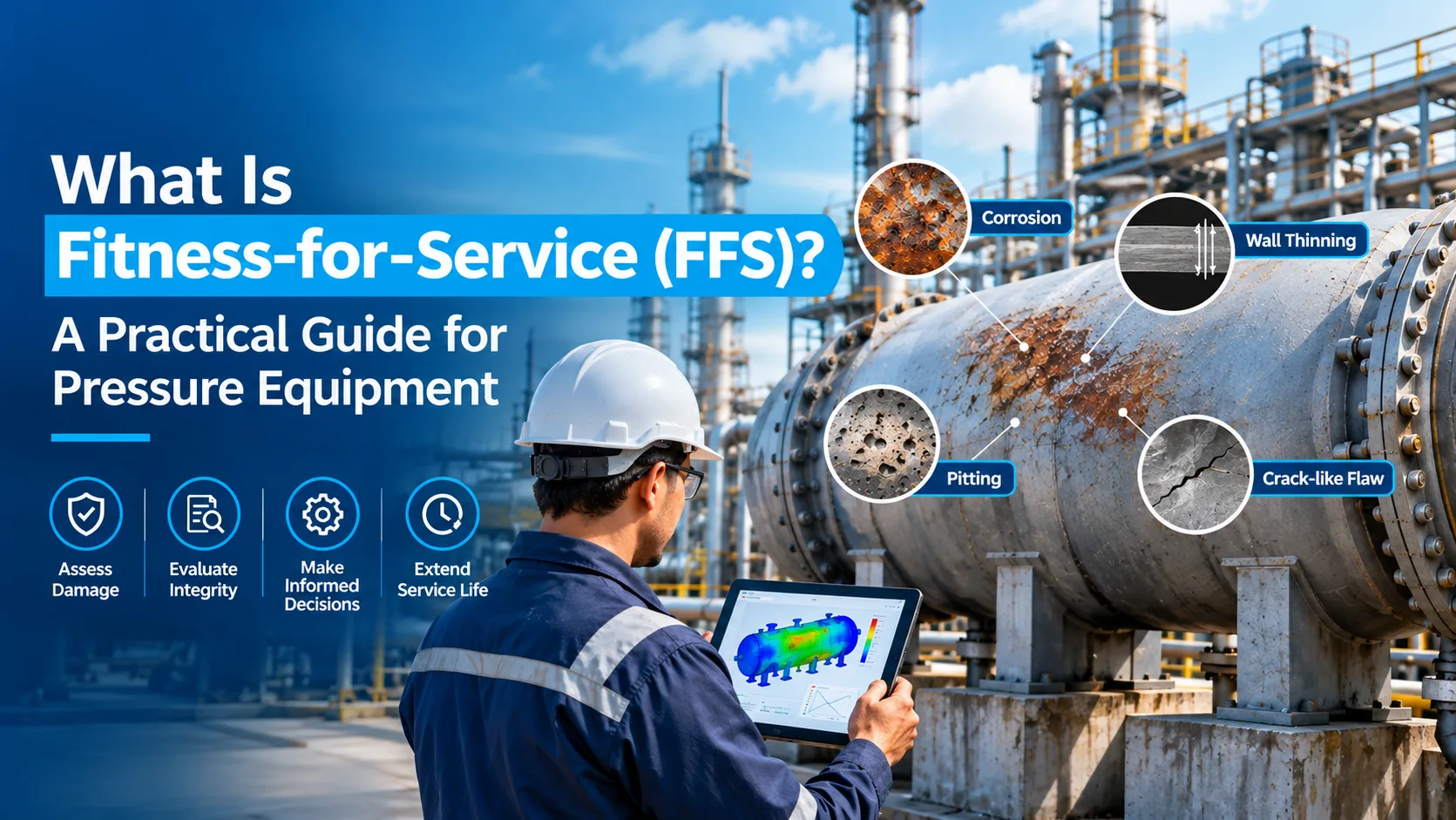
Pressure vessels, piping systems, storage tanks, and other industrial equipment can experience corrosion, cracking, wall thinning, deformation, fatigue, or other forms of damage during operation. When inspection identifies a defect, replacing the equipment immediately is not always the only engineering option.
Fitness-for-Service (FFS) is a structured engineering assessment used to determine whether in-service equipment containing flaws or damage can continue operating for a defined period under specified conditions. API 579-1/ASME FFS-1 provides recognized methodologies for evaluating the structural integrity of in-service pressure equipment and supporting run, repair, or replacement decisions.
For plant owners and engineering teams, FFS can help convert inspection findings into technically supported decisions while considering equipment condition, operating loads, materials, damage mechanisms, and remaining service requirements.
What Is Fitness-for-Service (FFS)?
Fitness-for-Service is a quantitative engineering evaluation performed on an in-service component that may contain a flaw, damage, or condition that could affect its structural integrity. The assessment determines whether the equipment can continue operating safely for a specified period and under defined operating conditions.
FFS is particularly relevant to equipment that has already been placed into service. Unlike conventional new-equipment design, where engineers work from an intended geometry and design condition, FFS starts with the actual condition of the equipment.
Typical equipment considered in FFS assessments includes:
- Pressure vessels
- Process piping
- Storage tanks
- Boiler and pressure-containing components
- Other applicable industrial pressure equipment
API 579-1/ASME FFS-1 is designed specifically to provide methodologies for evaluating in-service equipment with identified flaws or damage.
Why Is FFS Important for Pressure Equipment?
Industrial equipment can gradually deteriorate because of operating conditions, environmental exposure, cyclic loading, temperature, chemical interaction, or mechanical events.
For example, a pressure vessel may develop wall thinning because of corrosion. A piping system may experience fatigue-related cracking after repeated thermal cycles. A component may also suffer from dents, local metal loss, distortion, or other damage.
An inspection report can identify the presence and size of a defect, but engineering assessment is needed to understand what that defect means for structural integrity.
FFS provides a technical framework for evaluating questions such as:
- Can the equipment continue operating?
- What operating conditions are acceptable?
- Is repair required?
- Can the equipment remain in service until the next inspection?
- Is additional monitoring necessary?
- Does the equipment require replacement or rerating?
- What is the estimated remaining service capability?
The purpose is not simply to declare equipment “safe” or “unsafe.” A proper assessment considers the applicable damage mechanism, material properties, loading conditions, geometry, inspection data, and assessment criteria.
When Is a Fitness-for-Service Assessment Required?
An FFS assessment may become necessary when inspection or operational history identifies a condition that was not part of the original design assumptions.
Common situations include:
Corrosion and Wall Thinning
General corrosion, localized corrosion, erosion, or pitting can reduce the thickness of pressure-retaining components. FFS methods can be used to evaluate whether the remaining material is adequate for continued operation.
Cracks and Crack-Like Flaws
Cracks require careful engineering evaluation because their effect can depend on dimensions, orientation, material properties, stress levels, temperature, and loading history.
Mechanical Damage
Dents, gouges, distortion, or other mechanical damage may alter the geometry and stress distribution of equipment.
Fatigue Damage
Repeated pressure, temperature, vibration, or mechanical loading can create cyclic stresses. Where fatigue is relevant, engineers may evaluate whether existing or potential fatigue damage could affect service life.
High-Temperature Damage
Equipment operating at elevated temperatures can experience mechanisms such as creep and other temperature-dependent degradation. These conditions may require specialized engineering evaluation.
Hydrogen-Related Damage
Certain process environments can contribute to hydrogen-related damage, including blistering and cracking mechanisms. API/ASME FFS methodologies include assessment approaches for applicable hydrogen damage conditions.
Common Damage Mechanisms Evaluated in FFS
The appropriate assessment depends heavily on the type of damage identified.
Some commonly encountered conditions include:
Damage mechanism | Typical engineering concern |
General metal loss | Reduced wall thickness |
Local metal loss | Localized reduction in pressure-boundary thickness |
Pitting | Multiple or concentrated corrosion pits |
Crack-like flaws | Fracture and structural integrity |
Hydrogen damage | Blistering and cracking |
Mechanical damage | Dents, gouges, distortion |
Fatigue | Repeated cyclic loading |
Creep | Long-term high-temperature exposure |
Weld-related flaws | Local stress concentration or defects |
ASME’s FFS training materials specifically identify areas such as general and local metal loss, pitting, hydrogen damage, weld misalignment, shell distortion, crack-like flaws, and creep-related conditions among the assessment topics.
API 579-1/ASME FFS-1: The Key FFS Standard
API 579-1/ASME FFS-1 is one of the principal references used for Fitness-for-Service assessment of in-service pressure equipment.
The standard provides methodologies intended to help engineers evaluate equipment containing flaws or damage and make technically supported decisions regarding continued operation, repair, or replacement. It applies particularly to pressure vessels, piping, tanks, and related equipment within its scope.
The assessment approach is not a single calculation for every situation. Different damage mechanisms require different evaluation methods.
This is why accurate inspection data and correct identification of the damage mechanism are important before selecting an assessment procedure.
What Are the Different Levels of FFS Assessment?
FFS methodologies commonly use different levels of assessment depending on the complexity of the problem and the information available.
Level 1 Assessment
Level 1 is generally a simplified screening approach. It can be useful when the component condition and applicable assumptions fall within the requirements of the relevant procedure.
Because it uses simplified criteria and assumptions, it may not be appropriate for every complex geometry or damage condition.
Level 2 Assessment
Level 2 generally involves a more detailed engineering evaluation and can account for additional information about operating conditions, geometry, material properties, and damage characteristics.
It can provide a more detailed assessment than a basic screening calculation while avoiding the complexity of a highly customized numerical analysis where one is not necessary.
Level 3 Assessment
Level 3 is generally used for more complex or unusual cases where advanced engineering analysis is required. Depending on the assessment, this can involve detailed stress analysis, fracture mechanics, or numerical methods such as Finite Element Analysis (FEA).
The appropriate level should be selected based on the applicable standard, damage mechanism, component configuration, available data, and engineering requirements.
How Is a Fitness-for-Service Assessment Performed?
A typical FFS workflow can include the following steps:
Step 1: Collect Equipment Information
Engineers gather available drawings, design information, material specifications, operating history, inspection reports, previous repair records, and applicable construction codes.
Step 2: Understand the Actual Condition
Inspection data is reviewed to identify the location, size, depth, orientation, and characteristics of the observed damage.
Step 3: Identify the Damage Mechanism
The engineering team determines whether the condition is associated with corrosion, erosion, cracking, fatigue, mechanical damage, creep, hydrogen-related damage, or another applicable mechanism.
Step 4: Establish Operating Conditions
Relevant pressure, temperature, fluid characteristics, cyclic conditions, external loads, and other operating parameters are considered.
Step 5: Select the Appropriate Assessment Method
The applicable API 579-1/ASME FFS-1 methodology and assessment level are selected based on the equipment condition and damage mechanism.
Step 6: Perform Engineering Calculations
The assessment may include thickness calculations, stress evaluation, fracture mechanics, remaining-life calculations, fatigue evaluation, or detailed numerical simulation.
Step 7: Evaluate the Results
The calculated results are compared with the applicable acceptance criteria and engineering requirements.
Step 8: Define the Engineering Recommendation
Depending on the assessment, possible outcomes may include continued operation under defined conditions, additional monitoring, repair, rerating, or replacement.
How FEA Can Support FFS Assessment
For complex geometries, localized damage, unusual loading, or difficult stress distributions, conventional calculations may not fully describe the structural response.
In such cases, FEA can provide detailed information about:
- Stress distribution
- Local stress concentration
- Deformation
- Pressure and thermal loading effects
- Interaction between different loads
- Localized structural response
- Effects of geometry changes or repairs
A properly developed FEA model should use appropriate geometry, material properties, loads, constraints, mesh quality, and validation procedures. The simulation should support the applicable engineering assessment rather than replace engineering judgment.
This is where an experienced engineering service in India can provide value by combining inspection information with mechanical analysis, code knowledge, and numerical simulation.
Benefits of Fitness-for-Service Assessment
A technically appropriate FFS assessment can provide several practical benefits for asset owners.
Better Engineering Decisions
Instead of making a decision based only on the presence of a defect, engineers can evaluate its actual effect on structural integrity.
Support for Continued Operation
Where the assessment demonstrates that continued operation is acceptable under defined conditions, unnecessary replacement or premature shutdown may potentially be avoided.
Improved Maintenance Planning
FFS results can help engineering and maintenance teams understand where additional inspection, monitoring, repair, or replacement may be required.
Remaining-Life Evaluation
Depending on the applicable damage mechanism and methodology, engineering assessment can support evaluation of future service capability.
Reduced Unplanned Downtime
A structured engineering evaluation can help organizations make better-informed decisions when unexpected damage is discovered during inspection.
For organizations seeking specialized analysis, working with a Mechanical engineering design company in India with experience in pressure equipment, FEA, mechanical design, and engineering analysis can help connect inspection findings with practical engineering decisions.
FFS vs New Pressure Equipment Design
FFS and new equipment design serve different purposes.
New equipment design starts with requirements such as design pressure, design temperature, materials, geometry, loads, and applicable construction codes. Engineers then develop a design intended to satisfy those requirements.
FFS assessment, in contrast, starts with equipment that is already in service and may contain damage or degradation.
New equipment design | Fitness-for-Service |
Starts with design requirements | Starts with actual equipment condition |
Focuses on design and fabrication | Focuses on in-service integrity |
Uses intended geometry | Considers existing geometry and damage |
Establishes design adequacy | Evaluates continued service capability |
Used before or during construction | Used during the operating life |
The two disciplines can complement each other, particularly when an existing component requires detailed engineering evaluation.
Conclusion
Fitness-for-Service is an important engineering approach for evaluating damaged or degraded pressure equipment. It helps transform inspection findings into structured engineering decisions by considering the actual equipment condition, damage mechanism, materials, loads, operating conditions, and applicable assessment criteria.
API 579-1/ASME FFS-1 provides established methodologies for assessing in-service pressure vessels, piping, tanks, and other applicable equipment.
For complex cases, the assessment may require detailed stress analysis, fracture mechanics, fatigue evaluation, or FEA. The quality of the final result depends on reliable inspection information, appropriate engineering methods, and experienced technical interpretation.
Neocent Engineering supports engineering analysis and design requirements for industrial equipment, helping clients approach complex mechanical and structural engineering challenges with practical, analysis-driven solutions.
Frequently Asked Questions
What does Fitness-for-Service mean?
Fitness-for-Service is an engineering assessment used to determine whether in-service equipment containing flaws, damage, or degradation can continue operating for a specified period under defined conditions.
What is API 579-1/ASME FFS-1?
API 579-1/ASME FFS-1 is a recognized standard for Fitness-for-Service assessment of applicable in-service pressure equipment. It provides methodologies for evaluating flaws and damage in equipment such as pressure vessels, piping, and tanks.
When is an FFS assessment required?
An FFS assessment may be required when inspection identifies conditions such as corrosion, wall thinning, pitting, cracking, mechanical damage, hydrogen-related damage, fatigue, or other degradation that could affect equipment integrity.
Can FEA be used in Fitness-for-Service assessment?
Yes. For complex geometries, loading conditions, or localized damage, FEA can support detailed stress and structural analysis. The method and level of analysis should be selected according to the applicable FFS procedure and engineering requirements.
What is the difference between FFS and pressure vessel design?
Pressure vessel design establishes the requirements and configuration for new equipment, while FFS evaluates the integrity and continued service capability of equipment that is already in operation and may have flaws or damage.

Krupal Patel
Krupal Patel is the CEO of Neocent Engineering Pvt. Ltd., Ahmedabad, specializing in advanced engineering solutions. With over 8 years of expertise in Product Design, FEA, CFD, and ASME-BPVC stress analysis, he has successfully delivered high-precision projects across pressure vessels, piping, and structural systems.