
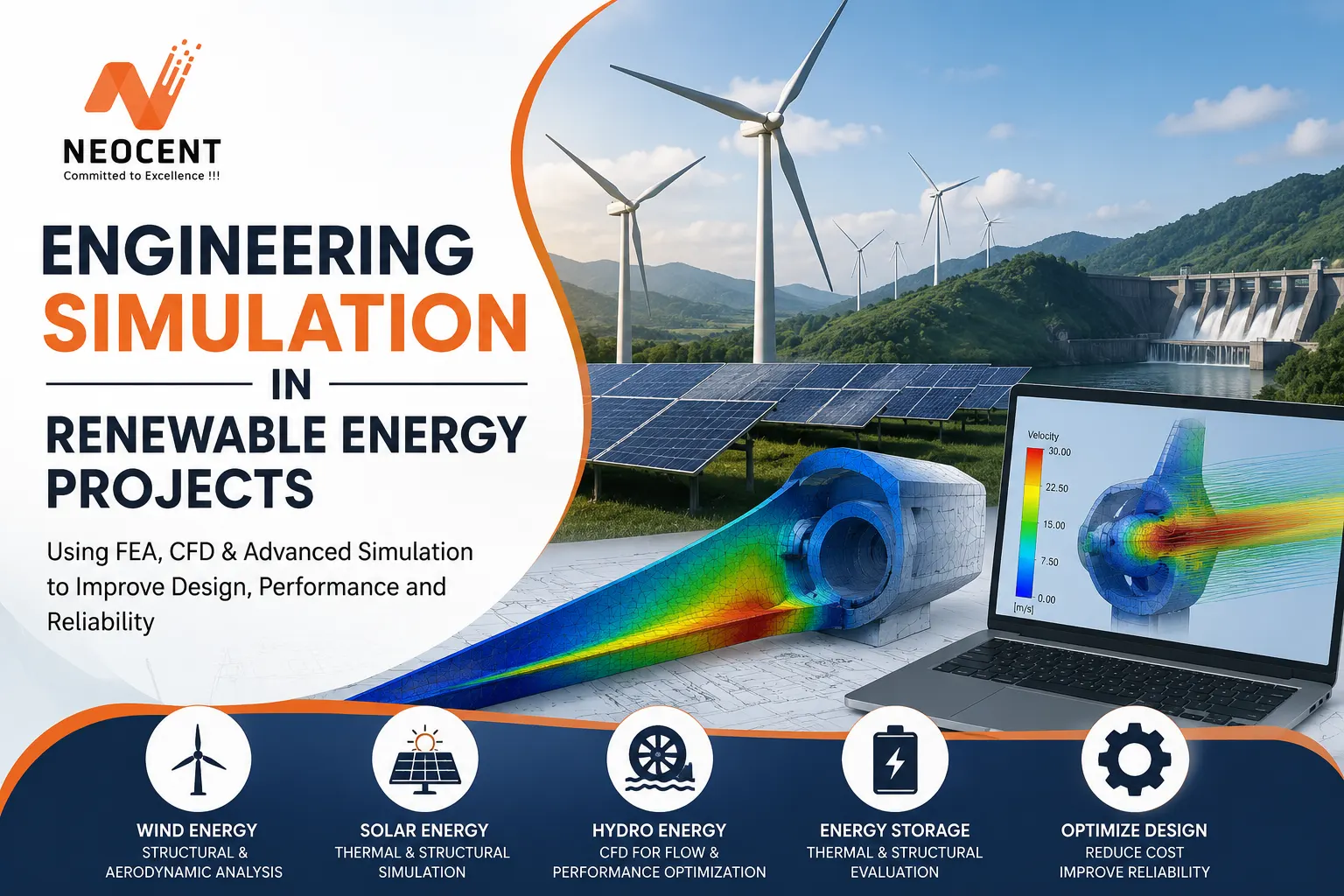
Renewable energy projects are becoming increasingly complex. Wind turbines, solar thermal systems, hydro equipment, battery systems, green hydrogen facilities, and hybrid energy plants must operate efficiently while handling demanding mechanical, thermal, structural, and environmental conditions.
This is where engineering simulation plays an important role. Using technologies such as Finite Element Analysis (FEA), Computational Fluid Dynamics (CFD), thermal simulation, fatigue analysis, and structural analysis, engineers can evaluate equipment performance before manufacturing or installation.
Modern renewable-energy engineering increasingly combines multiple disciplines. For example, wind-turbine simulation may involve aerodynamics, structural analysis, dynamics, controls, and cost considerations rather than evaluating each component independently.
For renewable energy developers, OEMs, EPC companies, and equipment manufacturers, simulation can help reduce design uncertainty, identify potential failures, optimize equipment, and improve overall project reliability.
What Is Engineering Simulation in Renewable Energy?
Engineering simulation is the use of computer-based mathematical models to predict how a component, equipment, or complete system will behave under real-world operating conditions.
Depending on the project, engineers may simulate:
- Mechanical and structural loads
- Wind and fluid flow
- Temperature and heat transfer
- Vibration and dynamic loading
- Fatigue and equipment life
- Pressure and stress
- Seismic and wind loads
- Thermal expansion
- Fluid-induced forces
- Equipment performance and efficiency
A properly developed simulation allows engineering teams to identify design weaknesses before committing to expensive physical prototypes or manufacturing changes.
Why Is Simulation Important for Renewable Energy Projects?
Renewable energy equipment is often exposed to variable and unpredictable operating conditions. Wind turbines experience changing wind speeds and turbulence, solar equipment faces temperature variations and environmental loads, while hydro systems operate under complex fluid-flow conditions.
For example, NREL uses high-fidelity modeling and validation to study wind-turbine structural behavior, including static strength and cyclic fatigue loading.
Simulation therefore becomes an important part of design validation and optimization.
Key Benefits
Engineering Challenge | Simulation Approach | Potential Benefit |
Excessive structural stress | FEA | Identify weak areas |
Wind loading | CFD + structural analysis | Optimize structure |
High temperature | Thermal analysis | Improve heat management |
Fluid losses | CFD | Improve flow efficiency |
Repeated loading | Fatigue analysis | Estimate service life |
Excessive vibration | Dynamic analysis | Reduce failure risk |
Heavy equipment | Design optimization | Reduce material/weight |
Complex operating conditions | Multiphysics simulation | Improve design confidence |
Applications of Engineering Simulation in Renewable Energy
Wind Turbine Design and Optimization
Wind turbines are exposed to continuously changing aerodynamic and structural loads. Blade geometry, tower structures, nacelles, foundations, and supporting components must withstand these loads over their operating life.
CFD can help engineers understand airflow, pressure distribution, turbulence, and wake behavior around turbine components. FEA can then be used to evaluate stresses, deformation, natural frequencies, and fatigue performance.
Advanced wind-energy research increasingly uses coupled simulations to understand the interaction between fluid flow and turbine structural dynamics.
Solar Energy Equipment
Engineering simulation is also useful for solar-energy equipment such as solar thermal systems, trackers, support structures, heat exchangers, and thermal storage equipment.
Thermal analysis can identify temperature distribution and thermal gradients, while structural analysis can evaluate wind, thermal expansion, and mechanical loading.
CFD can further help optimize air or fluid flow through thermal systems. This can improve heat transfer and help engineers identify areas where excessive temperature or pressure losses may occur.
Hydropower Systems
Hydropower equipment involves complex fluid behavior. CFD can be applied to turbines, pumps, waterways, valves, and other hydraulic components to study velocity distribution, pressure variation, turbulence, and flow separation.
Simulation can help engineers optimize hydraulic components before physical testing and reduce the number of design iterations.
Green Hydrogen and Energy Storage
Green hydrogen is creating new engineering challenges involving renewable electricity, electrolysers, compression, storage, cooling, and supporting equipment.
Recent research is increasingly using integrated modeling to evaluate renewable-powered hydrogen systems involving combinations of solar, wind, battery storage, electrolysers, and hydrogen-system components.
Mechanical and thermal simulation can support the development of equipment exposed to pressure, temperature, vibration, and cyclic operating conditions.
Offshore Renewable Energy
Offshore wind systems face additional challenges from wind, waves, currents, and structural dynamics.
Simulation can evaluate hydrodynamic loads, structural response, fatigue, and installation conditions. For floating offshore wind systems, coupled aero-hydro-servo-elastic analysis can be used to study the interaction between wind, waves, controls, and structural response.
FEA vs CFD: Which Simulation Is Required?
FEA and CFD solve different engineering problems, although they can also be used together.
FEA primarily evaluates structural and mechanical behavior such as stress, deformation, buckling, vibration, and fatigue.
CFD primarily evaluates fluid-flow and thermal behavior such as pressure, velocity, turbulence, heat transfer, and flow distribution.
In many renewable energy applications, using both can provide a more complete understanding of equipment performance.
For example, CFD can determine aerodynamic forces acting on a wind-turbine component, while FEA can use those forces to evaluate structural stresses and deformation.
Pros and Cons of Engineering Simulation
Pros | Cons |
Detects design problems before manufacturing | Requires accurate input data |
Reduces physical prototype requirements | Software and computing resources can be expensive |
Supports design optimization | Results depend on model assumptions |
Helps evaluate difficult operating conditions | Requires experienced engineers |
Can reduce development time | Complex multiphysics models can require significant time |
Supports performance and safety evaluation | Simulation should be validated where appropriate |
The key point is that simulation should not be treated as a substitute for engineering judgment. The quality of the result depends on the geometry, material properties, boundary conditions, loads, mesh, solver settings, assumptions, and validation approach.
How Mechanical Engineering Supports Renewable Energy Simulation
Renewable energy projects require more than simulation software. They require engineers who understand how mechanical components are designed, manufactured, assembled, and operated.
A mechanical design company in India can support renewable-energy OEMs and EPC companies with engineering calculations, equipment design, CAD modeling, structural analysis, CFD, FEA, and design validation.
Professional Mechanical Engineering Design Services can cover the complete process—from concept development and 3D modeling to detailed engineering, analysis, fabrication drawings, and design optimization.
Similarly, mechanical engineering consulting services can provide specialized engineering expertise when an organization needs additional technical capacity without building a large internal engineering team.
This integrated approach is particularly valuable when mechanical design and simulation need to work together. A design change identified through FEA or CFD can be incorporated directly into the CAD model and subsequently evaluated again.
How Neocent Engineering Can Support Renewable Energy Engineering
Neocent Engineering provides engineering capabilities covering 3D CAD modeling, structural stress analysis, FEA, CFD, mechanical calculations, and detailed engineering. Its published project portfolio includes CFD-based wind-turbine blade flow optimization, small-hydro vortex turbine flow optimization, and solar-heater thermal simulation.
Its engineering capabilities also include structural analysis, lifting and transportation analysis, fatigue-related evaluations, equipment structures, skid packages, and detailed fabrication drawings.
This combination allows renewable-energy companies to approach design and simulation as an integrated engineering workflow rather than as separate activities.
Frequently Asked Questions
What is engineering simulation used for in renewable energy?
Engineering simulation is used to evaluate structural strength, fluid flow, thermal behavior, vibration, fatigue, performance, and equipment reliability before or during the physical development process.
How does FEA help renewable energy equipment?
FEA helps engineers identify stress concentrations, deformation, buckling risks, vibration behavior, and fatigue-related concerns in components and structures.
How is CFD used in renewable energy?
CFD is used to study fluid flow, pressure, turbulence, heat transfer, aerodynamic behavior, and flow optimization in applications such as wind turbines, hydro turbines, pumps, and thermal systems.
Can simulation reduce renewable energy project costs?
Yes. Simulation can identify design issues earlier, reduce unnecessary physical iterations, support material optimization, and help prevent expensive redesigns. However, savings depend on project complexity and the quality of the engineering process.
Should FEA and CFD be used together?
When a project involves both fluid forces and structural response, combining CFD and FEA can provide a more complete engineering assessment. The appropriate approach depends on the specific equipment and operating conditions.
Conclusion
Engineering simulation is becoming an important part of renewable energy product development and project engineering. As equipment becomes larger, more efficient, and more complex, traditional design approaches alone may not provide sufficient insight into real-world operating behavior.
FEA, CFD, thermal analysis, fatigue analysis, and structural simulation can help engineers make better decisions before manufacturing and deployment. When these technologies are combined with strong mechanical design and engineering expertise, renewable energy companies can develop equipment that is safer, more efficient, reliable, and optimized for its intended operating conditions.
For renewable energy OEMs, EPC companies, equipment manufacturers, and technology developers, working with experienced engineering specialists can provide additional technical capability while supporting faster and more informed design decisions.

Krupal Patel
Krupal Patel is the CEO of Neocent Engineering Pvt. Ltd., Ahmedabad, specializing in advanced engineering solutions. With over 8 years of expertise in Product Design, FEA, CFD, and ASME-BPVC stress analysis, he has successfully delivered high-precision projects across pressure vessels, piping, and structural systems.