
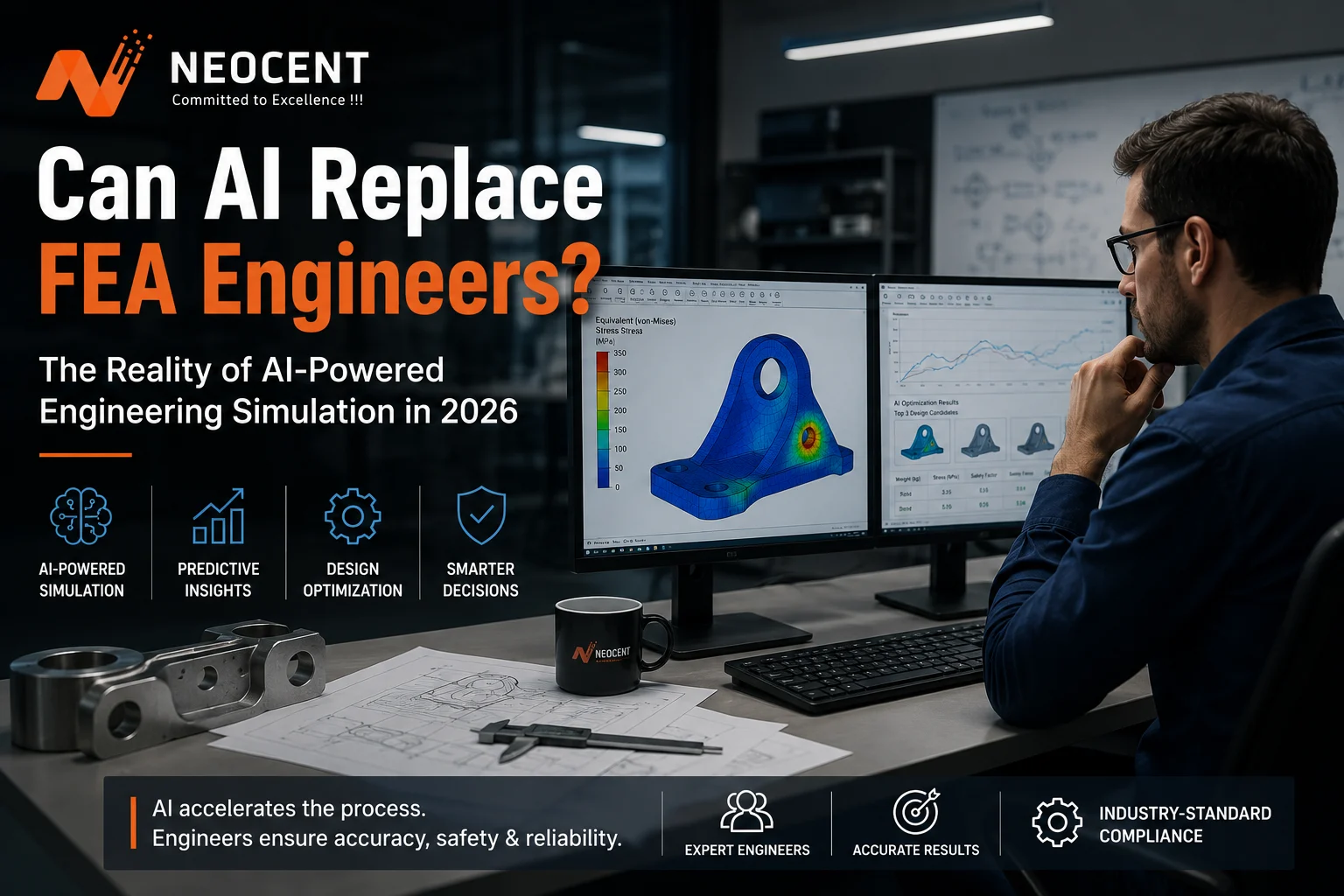
Artificial Intelligence (AI) is reshaping industries across the globe, and engineering is no exception. From automated CAD modeling to predictive maintenance and design optimization, AI-powered tools are becoming an integral part of modern product development.
This rapid advancement raises an important question for manufacturers, OEMs, EPC companies, and engineering professionals:
Can AI replace Finite Element Analysis (FEA) engineers?
The short answer is no – but AI is transforming how FEA engineers work.
While AI can automate repetitive tasks, generate design suggestions, and accelerate simulations, it cannot replace the engineering judgment, domain expertise, and critical decision-making required to validate complex designs.
In this article, we’ll explore the real impact of AI on engineering simulation, its limitations, and why experienced FEA professionals remain indispensable in 2026.
What Is AI-Powered Engineering Simulation?
AI-powered engineering simulation combines machine learning algorithms, optimization techniques, and historical engineering data with traditional simulation software.
Instead of manually creating multiple design iterations, AI can:
- Suggest optimized geometries
- Identify high-stress regions
- Predict structural behavior
- Reduce simulation setup time
- Recommend material alternatives
- Automate repetitive preprocessing tasks
These capabilities help engineering teams complete projects faster while reducing manual effort.
However, AI is still a support tool – not a replacement for engineering expertise.
What Can AI Do in Finite Element Analysis?
AI is particularly effective in improving productivity throughout the simulation workflow.
Faster Design Optimization
AI algorithms can evaluate hundreds of design variations within minutes, allowing engineers to identify lightweight, cost-effective, and high-performance solutions much faster than traditional methods.
Automated Mesh Generation
Generating high-quality meshes often consumes significant engineering time. AI-assisted meshing tools can automatically refine mesh quality around critical regions while reducing preprocessing effort.
Predictive Simulation
Using historical simulation data, AI models can estimate structural behavior before running a complete analysis. This helps engineers prioritize design options more efficiently.
Intelligent Error Detection
Modern AI tools can detect common modelling mistakes such as:
- Incorrect boundary conditions
- Missing contacts
- Material assignment errors
- Poor mesh quality
- Unrealistic loading conditions
These features improve simulation quality but still require human verification.
Where AI Falls Short
Despite impressive advancements, AI cannot independently deliver reliable engineering decisions for complex industrial applications.
Here are some critical limitations.
Engineering Judgment Cannot Be Automated
Every engineering project has unique operating conditions, manufacturing constraints, customer requirements, and safety considerations.
AI cannot fully understand:
- Real-world operating environments
- Industry-specific design practices
- Client performance expectations
- Manufacturing limitations
- Practical engineering trade-offs
Experienced engineers evaluate these factors before approving any simulation result.
AI Doesn’t Understand Engineering Intent
A simulation may indicate that a component is structurally safe.
But should it be redesigned for:
- Lower manufacturing cost?
- Improved fatigue life?
- Better serviceability?
- Reduced maintenance?
- Easier fabrication?
These strategic decisions depend on engineering experience rather than statistical predictions.
Safety-Critical Applications Need Human Validation
Industries including:
- Oil & Gas
- Power Generation
- Pressure Vessels
- Heavy Equipment
- Aerospace
- Automotive
- Industrial Machinery
cannot rely solely on AI-generated recommendations.
Design validation must comply with engineering standards such as ASME, API, ISO, and customer-specific requirements. Experienced engineers are responsible for interpreting simulation results, ensuring regulatory compliance, and confirming that designs meet safety margins.
AI + FEA Engineers: The Future Is Collaboration
Rather than replacing engineers, AI is becoming a powerful engineering assistant.
Think of AI as an advanced calculator.
It performs calculations rapidly.
But it cannot determine whether those calculations represent the safest or most practical engineering solution.
The most successful engineering organizations are combining AI tools with Expert FEA Consulting teams to improve productivity without compromising design quality.
This collaborative approach enables companies to:
- Reduce product development time
- Improve simulation accuracy
- Optimize product performance
- Minimize physical prototypes
- Lower development costs
- Accelerate time-to-market
Why Human Expertise Still Matters
Every simulation result requires interpretation.
For example, a stress contour may indicate a localized stress concentration.
An experienced engineer must determine:
- Is the stress physically realistic?
- Is it caused by mesh refinement?
- Is it acceptable according to design codes?
- Will fatigue become an issue?
- Does the material require modification?
- Should the geometry be redesigned?
These decisions cannot be made by AI alone.
Engineering remains a discipline built on experience, critical thinking, and problem-solving.
Benefits of Combining AI with Professional FEA Services
Organizations that integrate AI into their engineering workflows often experience measurable improvements.
Some key benefits include:
- Faster engineering turnaround
- Improved design optimization
- Reduced engineering costs
- Better product reliability
- Enhanced decision-making
- More efficient simulation workflows
- Earlier identification of design issues
- Reduced prototype testing
When combined with Finite Element Analysis Services India, AI becomes a productivity enhancer rather than a substitute for engineering expertise.
Choosing the Right Engineering Partner in the AI Era
Many businesses are adopting AI software, but technology alone doesn’t guarantee accurate engineering outcomes.
When selecting an engineering partner, look for companies that provide:
- Experienced simulation engineers
- Industry-specific expertise
- Code-compliant analysis
- Advanced simulation software
- Practical design recommendations
- Validation based on real engineering principles
The best finite element analysis companies combine cutting-edge technology with years of engineering experience to deliver reliable and actionable results.
The Future of FEA in 2026 and Beyond
AI will continue to transform engineering workflows through automation, optimization, and predictive analytics.
However, engineering simulation is about much more than running software.
It requires understanding physics, materials, manufacturing processes, safety regulations, and business objectives.
That combination of technical knowledge and engineering judgment remains uniquely human.
Rather than replacing engineers, AI is empowering them to solve more complex problems faster and more efficiently.
Organizations that embrace both AI technologies and FEA consulting services will be better positioned to innovate, reduce costs, and deliver higher-quality products in an increasingly competitive market.
Conclusion
AI is undoubtedly changing the engineering landscape, but it is not replacing Finite Element Analysis engineers.
Instead, it is enabling engineers to work smarter, automate repetitive tasks, and focus on higher-value engineering decisions.
Businesses seeking reliable simulation outcomes should combine advanced AI technologies with experienced engineering professionals who understand design intent, industry standards, and real-world performance requirements.
At Neocent Engineering, we combine modern simulation technologies with decades of engineering expertise to deliver accurate, efficient, and reliable engineering solutions. Whether it’s structural validation, design optimization, or complex simulation challenges, our team provides tailored engineering support that helps manufacturers reduce risk, improve product performance, and accelerate innovation.
As industries continue to evolve, Neocent Engineering remains committed to delivering high-quality engineering solutions powered by both advanced technology and experienced professionals.
Frequently Asked Questions (FAQs)
1. Can AI completely replace FEA engineers?
No. AI can automate repetitive tasks such as mesh generation, design optimization, and data analysis, but it cannot replace the engineering expertise needed to interpret simulation results, validate designs, ensure regulatory compliance, and make critical engineering decisions. Human judgment remains essential for complex engineering projects.
2. How is AI used in Finite Element Analysis (FEA)?
AI enhances Finite Element Analysis by accelerating simulation workflows, optimizing designs, improving mesh generation, predicting structural behavior, and identifying potential modeling errors. These capabilities help engineers reduce design cycles while maintaining accuracy, but AI works best as a support tool alongside experienced engineers.
3. Why should businesses choose Expert FEA Consulting instead of relying only on AI software?
AI software can generate faster results, but it cannot understand project-specific requirements, manufacturing constraints, industry standards, or safety regulations. Expert FEA Consulting provides engineering insights, code-compliant analysis, and practical recommendations that ensure reliable and accurate design validation.
4. What industries benefit most from Finite Element Analysis Services India?
Finite Element Analysis Services India are widely used across industries such as oil and gas, power generation, automotive, aerospace, heavy machinery, industrial equipment, process engineering, renewable energy, and manufacturing. FEA helps these industries improve product performance, reduce development costs, and minimize the need for physical prototypes.
5. How do I choose the right FEA consulting company?
When selecting an FEA consulting partner, consider their industry experience, engineering expertise, software capabilities, knowledge of international standards (such as ASME and API), project portfolio, and ability to deliver practical design recommendations. Reputable finite element analysis companies focus not only on simulation results but also on improving product reliability, safety, and overall engineering performance.

Krupal Patel
Krupal Patel is the CEO of Neocent Engineering Pvt. Ltd., Ahmedabad, specializing in advanced engineering solutions. With over 8 years of expertise in Product Design, FEA, CFD, and ASME-BPVC stress analysis, he has successfully delivered high-precision projects across pressure vessels, piping, and structural systems.