
Introduction
Pressure vessels are critical components across industries such as oil & gas, chemical processing, power generation, pharmaceuticals, and petrochemicals. Ensuring their safety, reliability, and compliance with international standards is essential for both operational performance and regulatory approval.
The American Society of Mechanical Engineers (ASME) Boiler and Pressure Vessel Code is the most widely recognized standard for pressure vessel design worldwide. Within ASME Section VIII, engineers commonly choose between Division 1 (Div 1) and Division 2 (Div 2) when designing pressure vessels.
While both divisions aim to ensure safe vessel operation, they differ significantly in design methodology, safety factors, engineering requirements, material utilization, and overall project costs.
This guide explains the key differences between Div 1 and Div 2 and helps you determine the most suitable approach for your project.
Understanding ASME Section VIII
ASME Section VIII governs the design, fabrication, inspection, testing, and certification of pressure vessels operating above 15 psi.
The section is divided into multiple divisions, with Div 1 and Div 2 being the most commonly used:
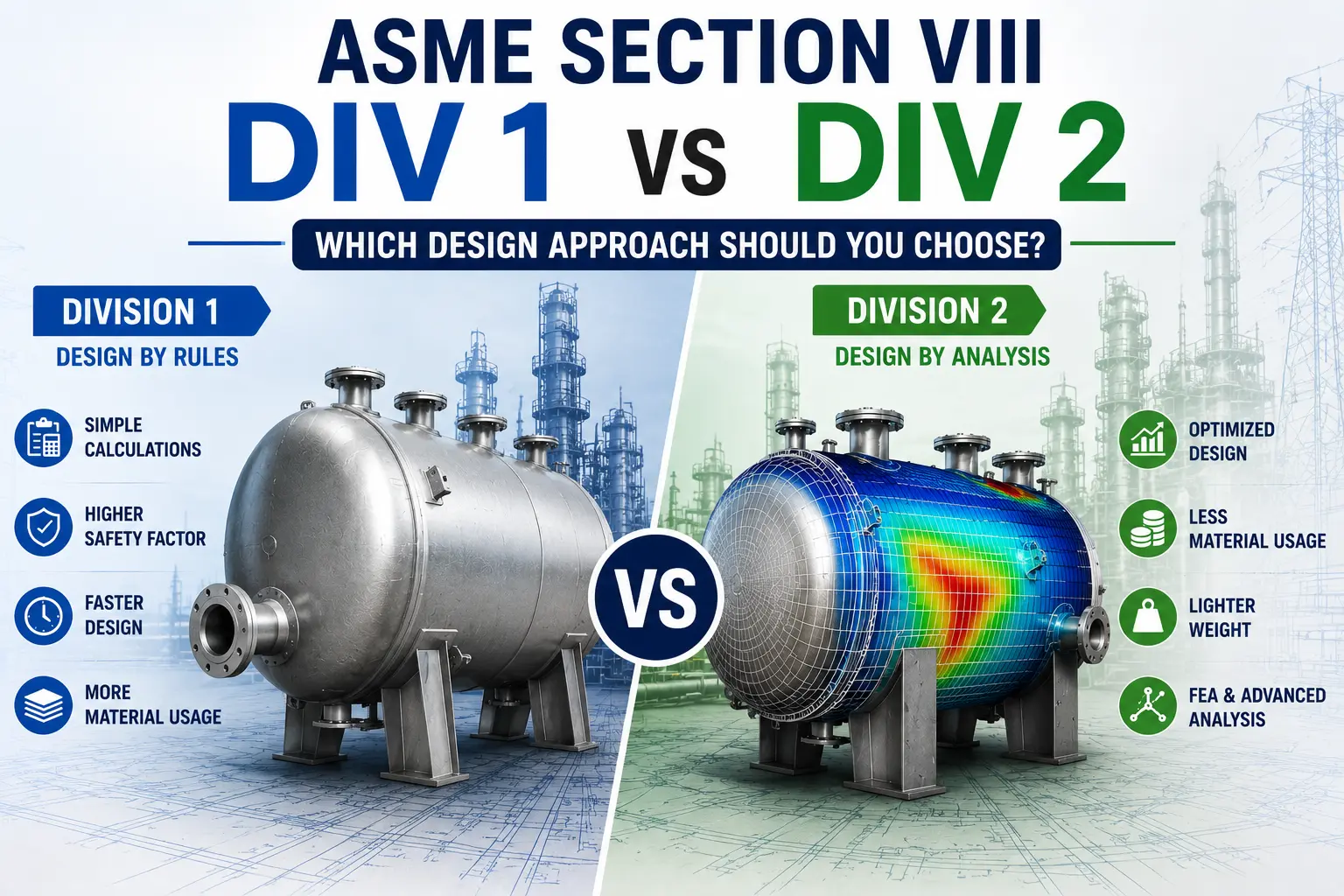
- Division 1: Design by Rules
- Division 2: Design by Analysis
Each division offers a different balance between engineering effort, manufacturing cost, and design optimization.
What is ASME Section VIII Division 1?
ASME Section VIII Division 1 is the most widely used pressure vessel code globally. It follows a Design-by-Rules approach, where engineers use predefined formulas and conservative design requirements to ensure vessel safety.
The code provides straightforward calculations for:
- Shell thickness
- Head design
- Nozzle reinforcement
- Support structures
- Pressure ratings
Because of its simplicity, Div 1 is often selected for standard industrial pressure vessels.
Advantages of Div 1
- Easier engineering calculations
- Faster design process
- Lower initial engineering costs
- Widely accepted worldwide
- Simpler documentation requirements
Limitations of Div 1
- Higher safety factors
- Increased material consumption
- Heavier vessel designs
- Less flexibility for complex geometries
What is ASME Section VIII Division 2?
ASME Section VIII Division 2 uses a Design-by-Analysis methodology that allows engineers to perform detailed stress evaluations and advanced calculations.
Instead of relying solely on conservative design formulas, Div 2 permits sophisticated engineering methods, including Finite Element Analysis (FEA), to optimize vessel performance while maintaining safety.
This approach often results in lighter, more efficient pressure vessel designs.
Advantages of Div 2
- Reduced material requirements
- Optimized vessel weight
- Lower fabrication costs
- Better performance for high-pressure applications
- Advanced stress analysis capabilities
Limitations of Div 2
- More complex engineering process
- Higher design effort
- Detailed documentation requirements
- Greater reliance on engineering expertise
ASME Div 1 vs Div 2: Key Differences
Parameter | Div 1 | Div 2 |
Design Method | Design by Rules | Design by Analysis |
Safety Factor | Higher | Lower |
Engineering Complexity | Lower | Higher |
Material Usage | Higher | Lower |
Vessel Weight | Heavier | Lighter |
Documentation | Basic | Extensive |
FEA Requirement | Limited | Frequently Required |
Initial Design Cost | Lower | Higher |
Manufacturing Cost | Higher | Lower |
Optimization Capability | Moderate | High |
The choice between Div 1 and Div 2 depends on project priorities, budget, operating conditions, and lifecycle cost considerations.
Cost Comparison: Which Division Saves More Money?
Many engineers assume Div 1 is always cheaper because its engineering requirements are simpler. However, the complete project cost tells a different story.
Div 1 Cost Structure
Div 1 typically offers:
- Lower engineering expenses
- Faster design approval
- Simpler calculations
However, the higher safety margins often require thicker vessel walls and additional material.
This leads to:
- Increased raw material costs
- Higher fabrication expenses
- Greater transportation costs
- Increased installation loads
Div 2 Cost Structure
Div 2 generally involves:
- Higher engineering costs
- Detailed stress analysis
- Advanced design verification
However, optimized thickness calculations often reduce material consumption significantly.
For large vessels and high-pressure systems, these material savings frequently outweigh the additional engineering investment.
As a result, Div 2 often delivers lower total project costs despite higher design complexity.
When Should You Choose ASME Div 1?
Division 1 is often the preferred option when:
Standard Industrial Applications
Common storage tanks and process vessels typically perform well under Div 1 requirements.
Smaller Pressure Vessels
The material savings achievable through Div 2 may not justify additional engineering costs for smaller equipment.
Faster Project Timelines
Projects requiring quick turnaround often benefit from Div 1’s simpler design process.
Budget-Conscious Engineering
Organizations seeking lower upfront engineering expenses may prefer Div 1.
When Should You Choose ASME Div 2?
Division 2 becomes attractive when:
High-Pressure Applications
Advanced stress analysis provides more efficient solutions for demanding operating conditions.
Large Pressure Vessels
Material savings become substantial as vessel size increases.
Weight-Sensitive Projects
Industries such as offshore, marine, and modular processing plants benefit from reduced equipment weight.
Material Cost Optimization
Projects involving expensive alloys can generate significant savings through optimized design.
Advanced Engineering Projects
Complex geometries and non-standard configurations often require detailed analytical methods.
The Role of FEA in ASME Division 2 Design
Finite Element Analysis plays a critical role in modern Div 2 pressure vessel engineering.
FEA enables engineers to evaluate:
- Stress distribution
- Local stress concentrations
- Thermal expansion effects
- Fatigue behavior
- Buckling resistance
- Nozzle load impacts
This level of analysis allows engineers to optimize vessel thickness while maintaining full code compliance.
Organizations seeking ASME Design & Analysis Services India increasingly rely on FEA-driven design approaches to improve performance and reduce manufacturing costs.
Professional ASME Expert engineering teams use advanced simulation tools to ensure accurate compliance with ASME requirements while maximizing design efficiency.
Industry Applications of Div 1 and Div 2
Both divisions are used extensively across multiple industries:
Oil & Gas
- Separators
- Pressure vessels
- Storage systems
Chemical Processing
- Reactors
- Heat exchangers
- Process vessels
Power Generation
- Steam systems
- Boiler components
- High-pressure equipment
Petrochemical Facilities
- Refinery vessels
- Process units
- Storage infrastructure
Hydrogen and LNG Projects
- High-pressure storage systems
- Cryogenic equipment
- Specialized pressure vessels
How to Select the Right ASME Design Approach
Choosing between Div 1 and Div 2 requires evaluating:
- Operating pressure
- Vessel size
- Material costs
- Fabrication budget
- Engineering resources
- Regulatory requirements
- Long-term operational goals
For smaller and standard applications, Div 1 often provides an economical solution. For larger, high-pressure, or weight-sensitive projects, Div 2 frequently delivers superior lifecycle value.
Working with experienced providers of ASME Pressure Vessel Design Services helps organizations determine the most cost-effective and technically appropriate solution.
Conclusion
Both ASME Section VIII Division 1 and Division 2 provide safe and reliable pressure vessel design methodologies. The best choice depends on the project’s technical requirements, budget constraints, and long-term performance objectives.
Division 1 offers simplicity, faster execution, and lower engineering costs, while Division 2 provides optimized designs, reduced material usage, and greater efficiency through advanced analysis techniques.
For companies seeking reliable ASME Design & Analysis Services India, partnering with experienced engineering specialists can significantly improve project outcomes. Neocent Engineering supports manufacturers with advanced pressure vessel design, FEA validation, and ASME code compliance solutions. Whether your project requires Div 1 calculations or sophisticated Div 2 analysis, Neocent Engineering helps deliver safe, optimized, and cost-effective engineering solutions.

Krupal Patel
Krupal Patel is the CEO of Neocent Engineering Pvt. Ltd., Ahmedabad, specializing in advanced engineering solutions. With over 8 years of expertise in Product Design, FEA, CFD, and ASME-BPVC stress analysis, he has successfully delivered high-precision projects across pressure vessels, piping, and structural systems.