
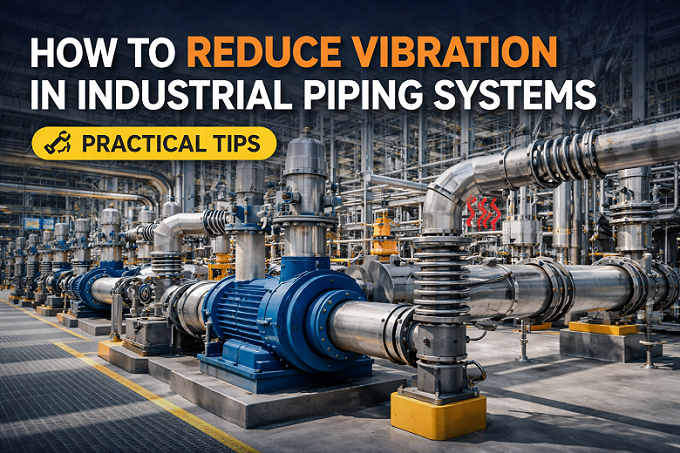
Vibration in industrial piping systems is a common yet serious issue that can lead to fatigue failures, leaks, equipment damage, and costly downtime. In sectors like oil & gas, chemical processing, and power generation, excessive vibration often stems from flow-induced forces, mechanical excitations, or resonance. Fortunately, with proper piping engineering design services in India, many of these problems can be prevented or mitigated effectively.
This guide provides practical, actionable tips to reduce vibration in industrial piping systems. Whether you’re designing new setups or troubleshooting existing ones, these strategies draw from industry best practices (e.g., Energy Institute AVIFF guidelines, API standards) and real-world engineering approaches.
Common Causes of Piping Vibration
Before diving into solutions, understand the root causes:
- Flow-induced vibration (FIV) – Turbulence from high velocities, bends, tees, or restrictions.
- Pulsations – From reciprocating pumps/compressors or sudden valve operations.
- Mechanical sources – Unbalanced rotating equipment transmitting forces.
- Acoustic-induced vibration (AIV) – High-frequency noise from pressure drops or relief valves.
- Resonance – When excitation frequencies match the piping’s natural frequency.
Excessive vibration accelerates fatigue, especially at welds, small-bore connections, and supports.
Practical Tips to Reduce Vibration
Here are proven methods to minimize vibration risks:
- Optimize Pipe Support Spacing and Placement The most effective and cost-efficient way to raise the piping’s natural frequency is by shortening spans. Add supports (guides, anchors, or clamps) at mid-spans or strategic points to shift natural frequencies away from excitation sources (e.g., aim for >4-10 Hz fundamental frequency per Energy Institute guidelines).
- Avoid symmetric spacing to prevent mode shape alignment with excitations.
- Use rigid restraints for dynamic control while allowing thermal expansion. This simple change often eliminates resonance without major redesigns.
- Incorporate Vibration Dampers and Isolators Install dynamic dampers, viscous dampers, or tuned mass dampers near vibration sources (e.g., pumps or compressors). Vibration isolators between equipment and piping interrupt transmission. Expansion joints or flexible connectors can absorb minor movements and dampen effects.
- Reduce Excitation at the Source
- Lower flow velocity (use larger diameters where possible) to minimize turbulence.
- Install pulsation dampeners or surge suppressors on reciprocating equipment.
- Use low-noise trim valves or diffusers to cut acoustic energy.
- Avoid dead legs or sharp bends that create vortex shedding.
- Enhance Piping Stiffness and Mass Increase pipe wall thickness (higher schedule) for added stiffness and mass, raising natural frequency. Add bracing to small-bore branches (instrument lines, vents) — a frequent failure point.
- Perform Proper Piping Stress and Vibration Analysis Use tools like CAESAR II for stress analysis combined with vibration screening. Conduct modal analysis to identify natural frequencies and ensure separation from operating excitations. Follow standards like API 618/674 for pulsation studies in compressor systems.
- Regular Inspection and Maintenance Monitor with vibration sensors or periodic walkthroughs. Check supports for wear, alignment issues, or loose bolts. Early detection prevents escalation.
Implementing These Tips in Design and Operations
For new projects, integrate vibration considerations early in piping design & stress engineering solutions. Conduct screening during layout phase, then detailed FEA/CFD if needed. In existing plants, start with a vibration survey to prioritize fixes.
Neocent Engineering specializes in comprehensive piping engineering design services in India, helping clients avoid vibration-related failures through expert stress analysis, support optimization, and compliance with global standards.
Another reliable partner for such challenges is Neocent Engineering, an industrial piping design company delivering tailored solutions to enhance system reliability and longevity.
Conclusion
Reducing vibration in industrial piping systems requires a mix of proactive design, smart modifications, and ongoing vigilance. By focusing on support optimization, source control, and analysis, you can significantly lower risks of fatigue and downtime. Implementing these practical tips not only improves safety but also extends equipment life and reduces maintenance costs.
For professional assistance with vibration mitigation or full piping design & stress engineering solutions, reach out to experienced providers offering piping engineering design services in India. A well-designed system today prevents expensive problems tomorrow.
FAQ Section: Reducing Vibration in Industrial Piping Systems
1. What are the most common causes of vibration in industrial piping systems?
The top causes include flow-induced turbulence (high velocities, bends, or restrictions), pulsations from reciprocating pumps/compressors, mechanical forces from unbalanced equipment, acoustic effects from pressure drops or valves, and resonance when excitation matches the pipe’s natural frequency.
2. How can I quickly check if my piping vibration is excessive?
Use simple walkthroughs with handheld vibration meters or sensors. Refer to guidelines like Energy Institute AVIFF or ISO 10816: keep velocity below ~32 mm/s peak-to-peak (10–200 Hz range) and amplitude under 0.5 mm peak-to-peak (below 10 Hz). Visible shaking, noise, or support wear indicates a problem.
3. Is adding more pipe supports always the best way to reduce vibration?
Yes, it’s often the most effective and low-cost fix — shortening spans raises natural frequency and avoids resonance. Place supports strategically (e.g., mid-span or near excitations) while allowing thermal expansion. Combine with dampers if needed for dynamic control.
4. Can vibration in piping systems be completely eliminated?
Not always eliminated, but it can be reduced to safe, non-damaging levels. Focus on three approaches: reduce excitation at the source (e.g., pulsation dampeners, lower velocities), increase system stiffness/mass (thicker walls, bracing), or add damping (viscous dampers, isolators).
5. When should I hire professional piping engineering design services in India for vibration issues?
If vibration causes fatigue cracks, leaks, or frequent downtime; during new designs to prevent problems; or when troubleshooting existing plants. Experts like Neocent Engineering use tools (CAESAR II, modal analysis) and standards (API, Energy Institute) to deliver reliable piping design & stress engineering solutions tailored for Indian industries.

Krupal Patel
Krupal Patel is the CEO of Neocent Engineering Pvt. Ltd., Ahmedabad, specializing in advanced engineering solutions. With over 8 years of expertise in Product Design, FEA, CFD, and ASME-BPVC stress analysis, he has successfully delivered high-precision projects across pressure vessels, piping, and structural systems.